


 JustApt
Quarter-end review period. The HR team is trying to bring together the results of hundreds of employees from different spreadsheets; seeing a department's real competency gap is a compilation job that takes weeks. Which training is assigned to whom is also, most of the time, decided not with data but by a manager's observation.
The request that came to Karatsoft was to add a learning management system to this picture. During the analysis we saw something else, and we changed the scope together.
The project in brief
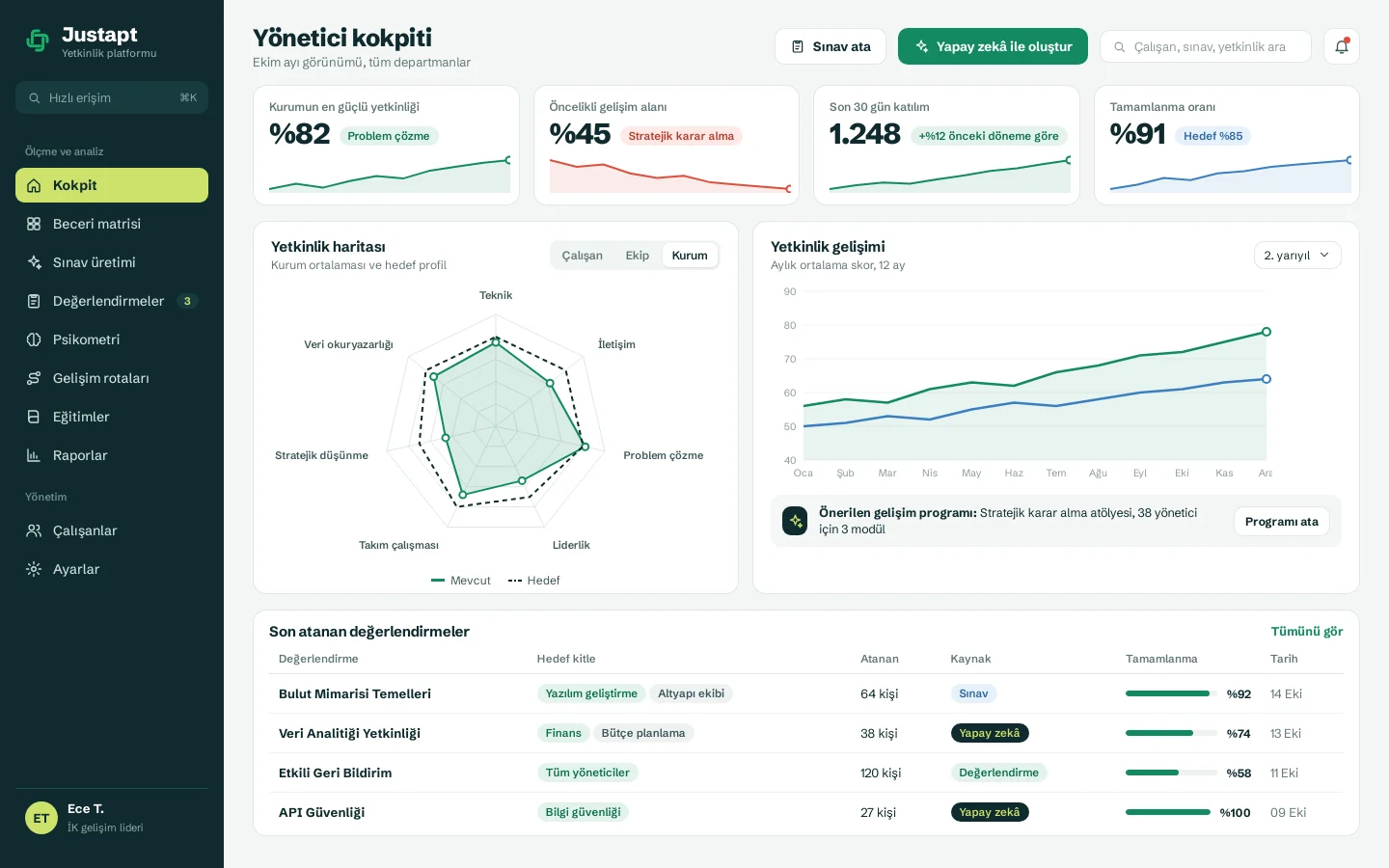
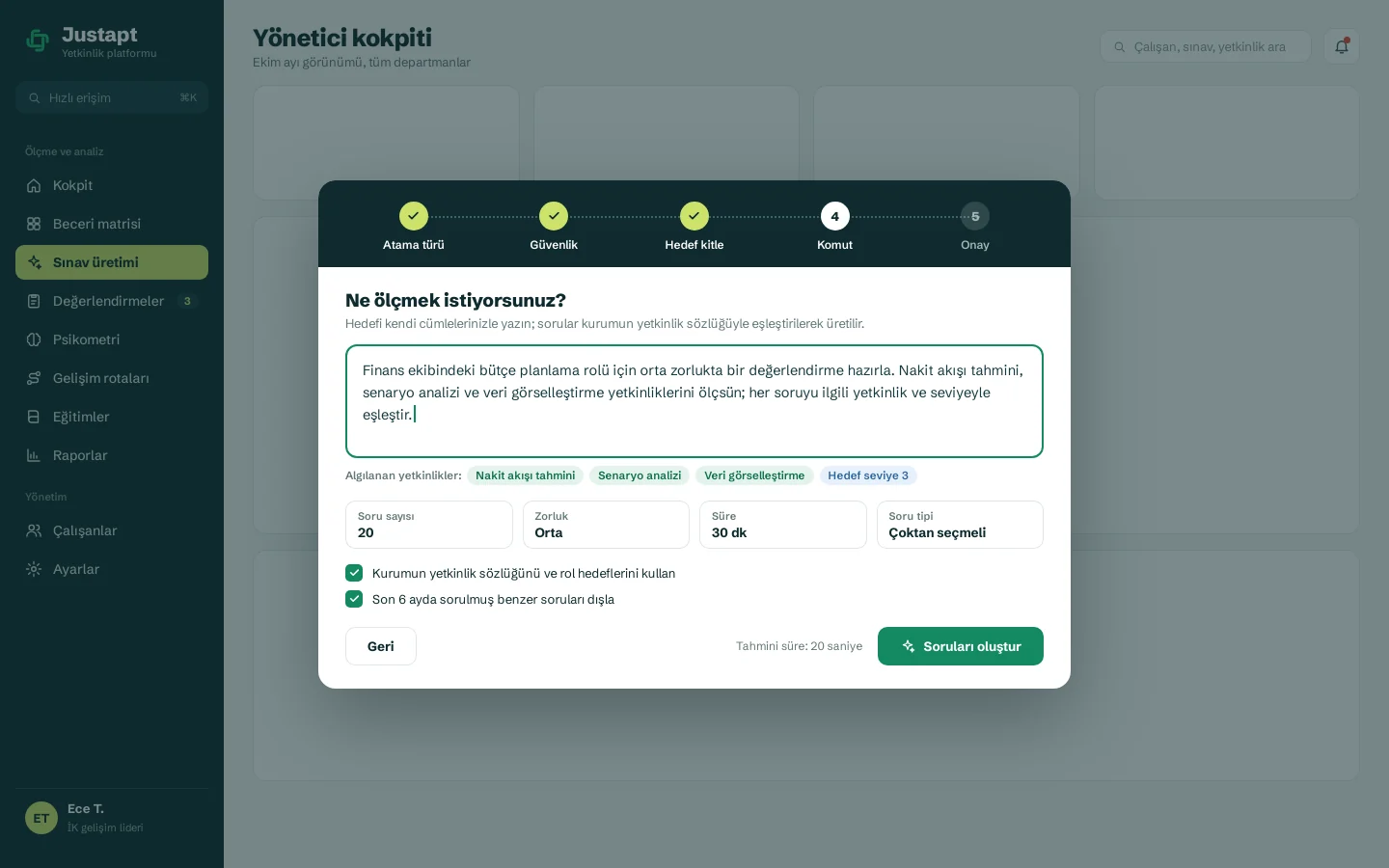
JustApt is an AI-powered competency measurement and development platform we developed for a large organization with thousands of employees. AI exam generation, psychometric measurement, competency analytics and learning management work under one roof. Managers, instructors and employees use the same data model, but each sees an interface focused only on their own work. The platform connects to the organization's HR, identity and organization systems through an API; the architecture was built with KVKK (Turkish Personal Data Protection Law) and GDPR requirements in mind.
The turning point: a competency that cannot be measured cannot be matched
A learning management system can manage course assignment, the calendar and completion rates well; but it cannot, on its own, tell which employee needs which course. In the analysis we saw that the real problem was not the training content but measurement: a competency that cannot be measured cannot be matched with the right training. So we broadened the scope and designed an end-to-end chain running from measurement to development: generate the exam, administer it, analyze, find the gap, assign the development path, track progress.
We designed the chain as a service flow. First the current state is analyzed: the skills library, the organization's existing HR assessments and the HR inventory are brought together. Then the competency matrix is built, topics and questions are matched to competencies, and exams and inventories are administered. The last link is person-based reporting: root competency analysis, skills map, strengths and weaknesses, and development areas.
The first link in the chain was conceptual, not technical. Departments used the same competency under different names and with different level definitions; without tying questions, results and career steps to a common dictionary, no meaningful comparison was possible. We tied all competencies to a single five-level model: needs development, beginner, basic, competent and can coach. Target levels were defined for every role. If the organization already had a competency matrix, that data was brought into the model; if not, the matrix was built inside the platform. Exams, the skills matrix, career steps and the training catalog are now all fed from the same dictionary.
The gap in levels, not in colors
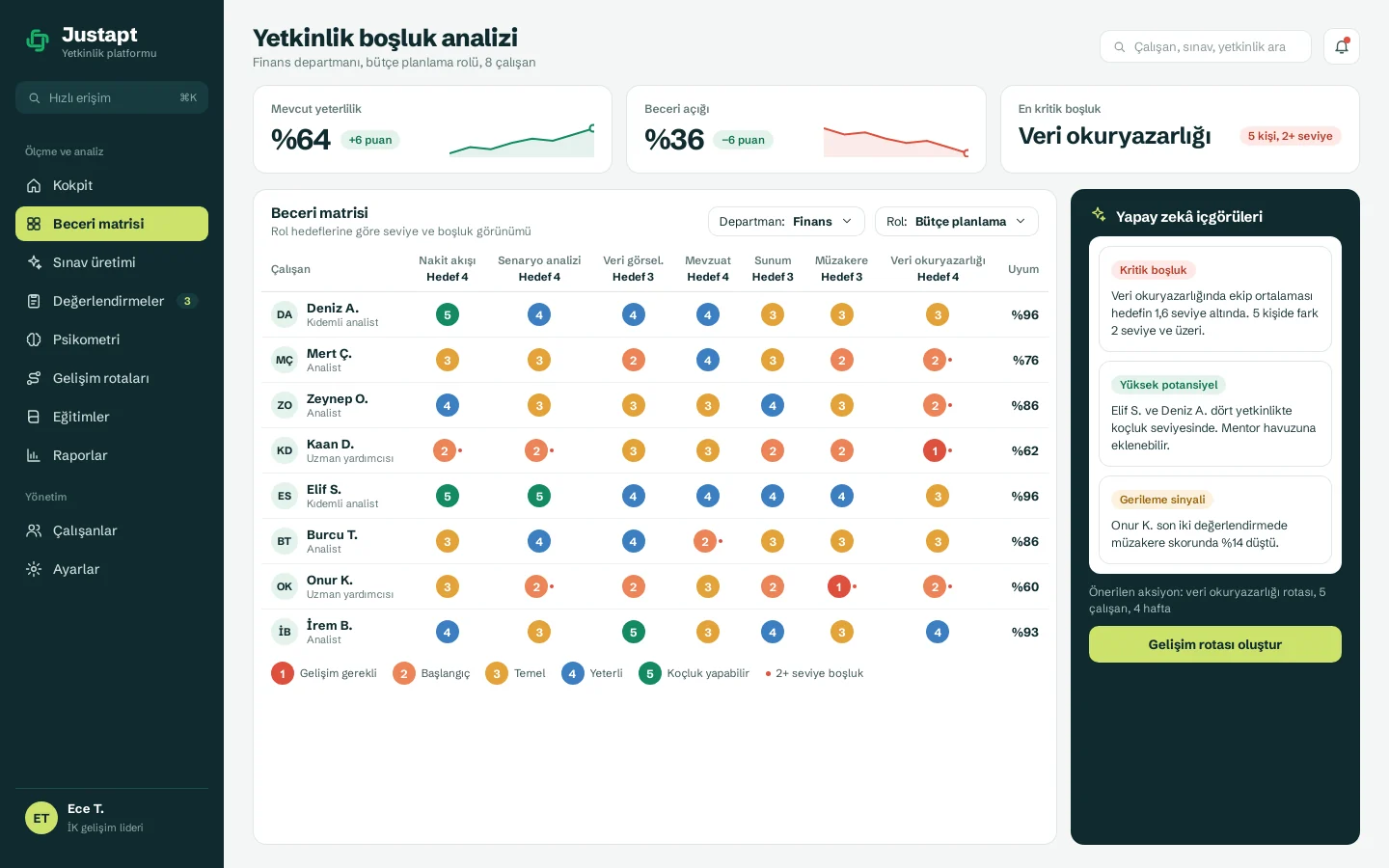
Once a common language was in place, the gap became visible. In the skills matrix, when a department and role are selected, the target levels are loaded automatically; each employee's level in each competency sits next to the level the role expects. The gap is measured not as a shade of color but as a level difference, and differences of two or more levels are marked separately. The AI insights panel automatically brings critical gaps, high-potential employees and signs of decline to the front. The competency map in the manager cockpit makes the same comparison at the employee, team and organization levels; the twelve-month development trend also points to the areas showing a decline. The gap analysis can be read separately at the organization, unit and candidate levels; in the individual report, recommendations are divided into short-, medium- and long-term.
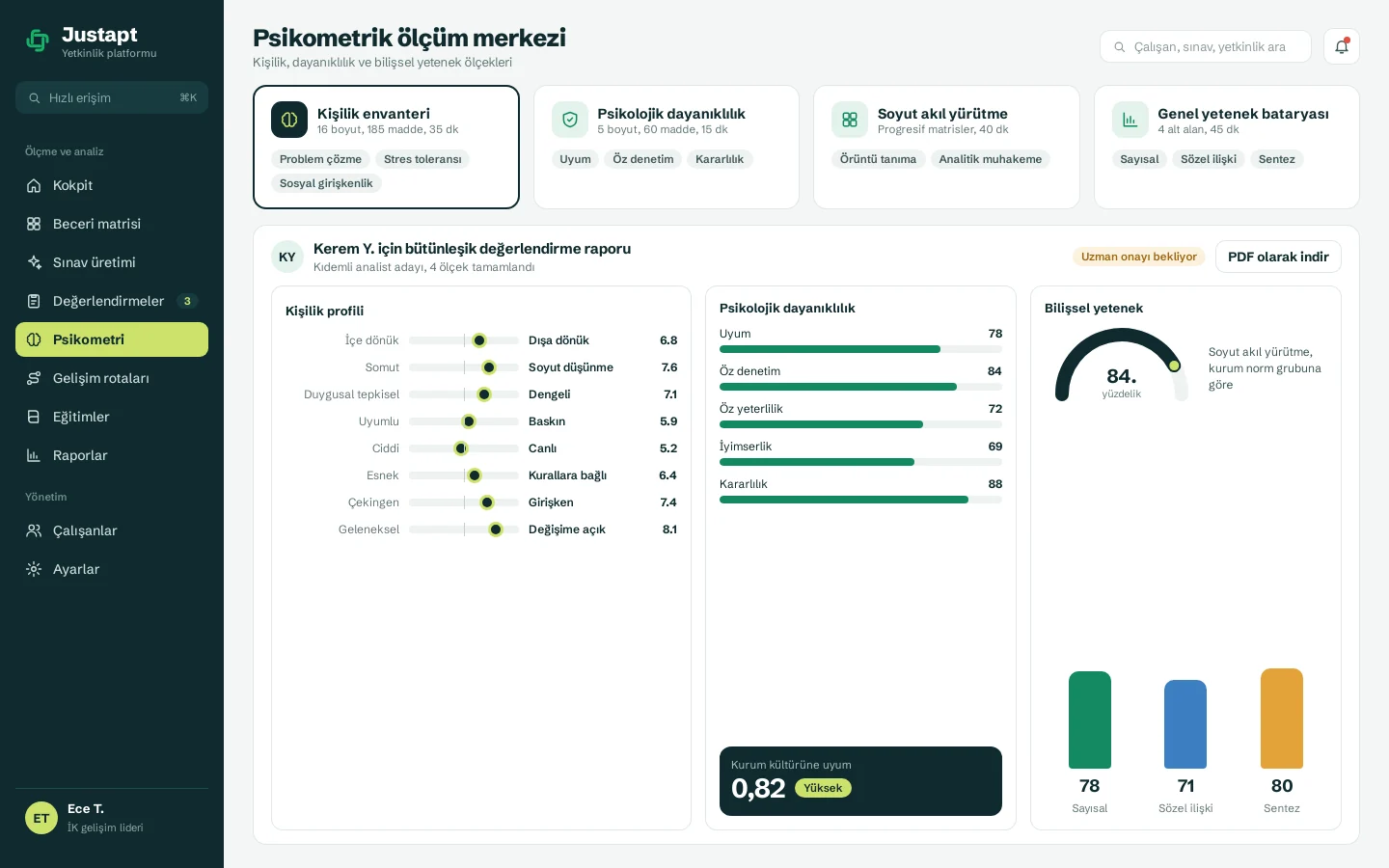
Alongside knowledge exams, personality, resilience and cognitive ability are also measured. The four psychometric scales run with their own scoring algorithms, the results are combined in a single candidate report, and behavioral tendencies are compared with the profile the organization expects to produce a culture fit score. The final report is published after the subject-matter expert approves it.
From gap to path: no data is moved by hand
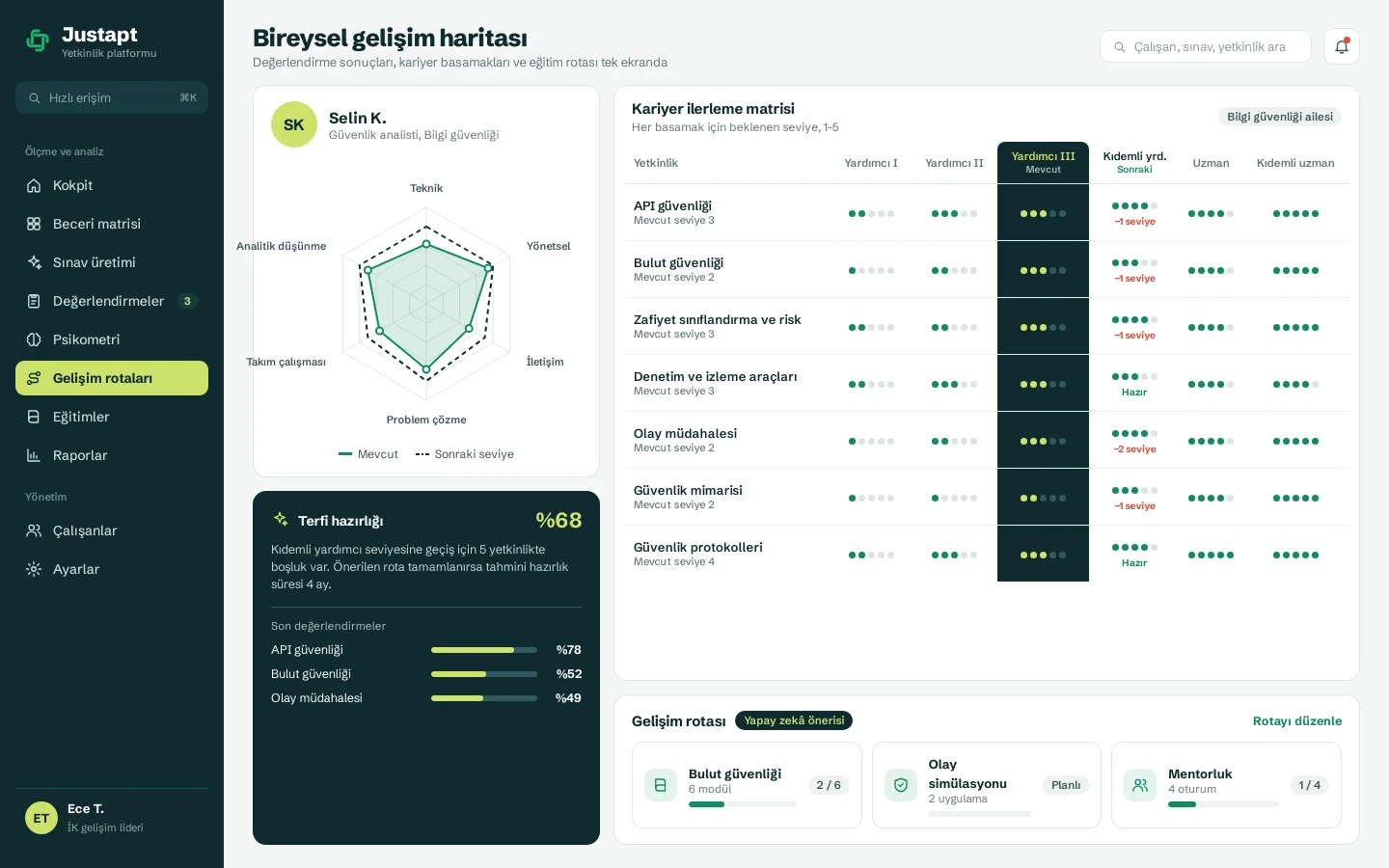
The meaning of measurement emerges in the step that follows. Results are automatically matched to career steps; the employee sees on their own screen how far short they fall in which competency for the next step. The promotion readiness indicator calculates an estimated readiness time based on the number of gaps and the recommended path. The development path consists of training, practice and mentoring steps, and these steps are selected from the organization's own training catalog.
The learning management system requested at the start also finds its place here: courses, classes, assignments, calendar, announcements, messaging and newsletters are managed from a single center. The difference is that data now decides who takes a course. Instructors manage the course catalog, classes and learner groups and follow learner progress in real time. Badges, points and streaks also support continuity in learning. In the learner area, employees pick up where they left off; each course card shows the completion percentage and the next lesson, and their reports show the weekly trend of assessment performance. Assignment due dates, live classes and exams are also gathered in a role-based calendar.
What we learned in the field
- Look for the question behind the request. What was asked for was a learning system; what needed to be solved was the question of “who needs which training.”
- The dictionary comes before the software. Until the five-level shared model was in place, no report was comparable across departments.
- Show the gap in a measurable unit. Saying “a two-level difference” instead of “red cell” makes the conversation between manager and employee concrete.
- Protect sensitive data during development too. Development and staging environments were completely separated from production, and only masked data was used in them.
A training platform's success is measured not by the number of courses completed but by how quickly the right person is directed to the right development step. For that, you first need to measure.
What drives development decisions in your organization?
If your training assignments rest on observation, or your competency data is scattered across different spreadsheets, we can design together a structure that runs from measurement to development. You can examine all of the platform's engines on the JustApt project page and talk to us through our contact page.
About the author
Zeynep Çelik
Digital Content Specialist
She is part of Karatsoft's digital content team and writes blog articles. She explains in clear language which need each project and product answers and how it works in practice.



Comments
0No comments yet. Be the first to comment!
Leave a Comment
Feel free to share your thoughts and feedback with us.