


 JustApt
Preparing an assessment for a role used to take expert teams weeks. Questions were written by hand, matched to competencies one by one and reviewed; then the same work started all over again for the next role.
In JustApt, the manager starts this process with a sentence of their own. But the real hero of the story is not speed; it is how that speed is achieved without taking expert control out of the process.
The project in brief
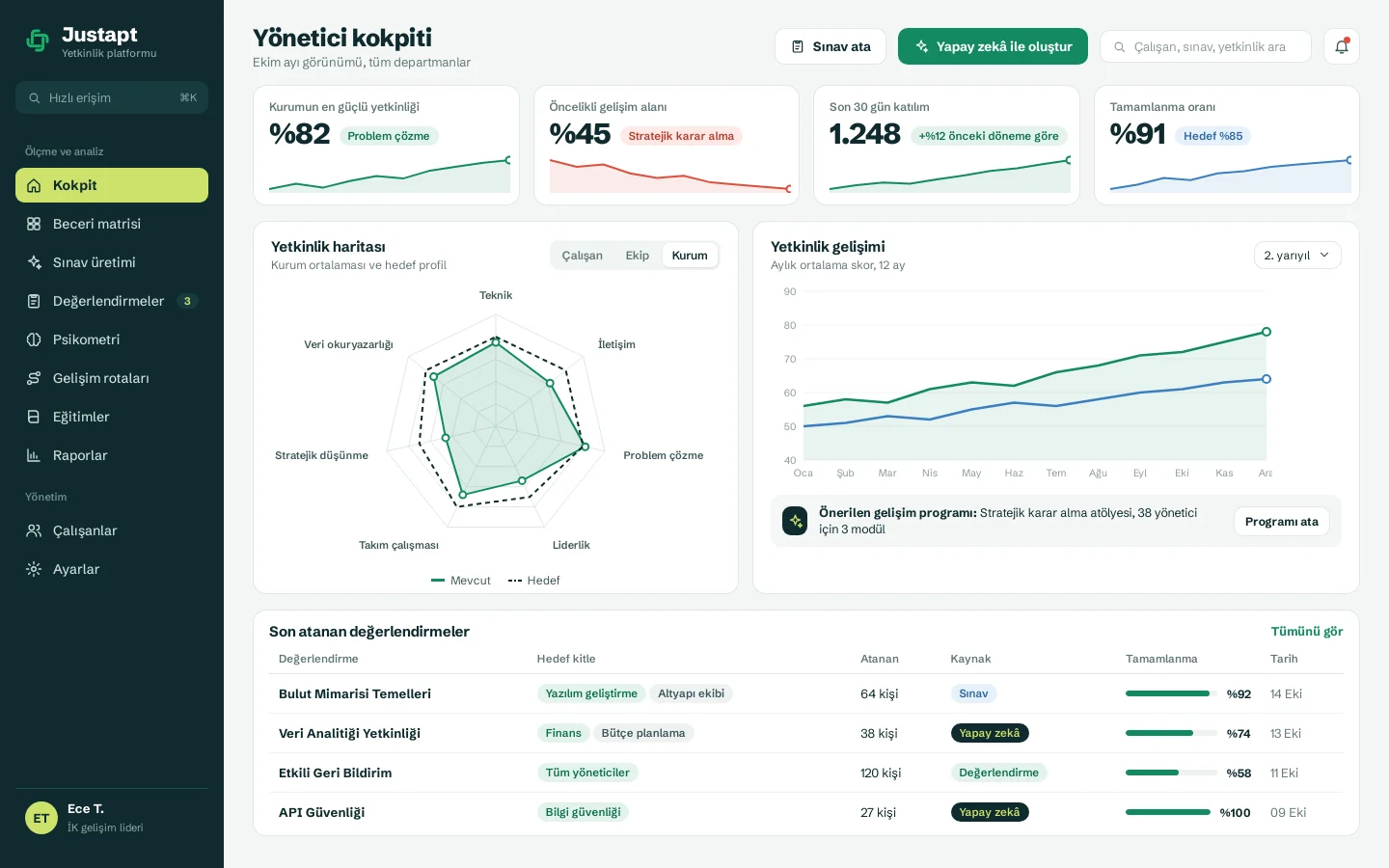
JustApt is an AI-powered competency measurement and development platform we developed for an organization with thousands of employees. It measures employees' technical and behavioral competencies, shows the gap between them and the level the role expects, and builds the development path that will close that gap. Exam generation, psychometric measurement, competency analytics and learning management work under one roof, on a shared five-level competency dictionary. In the manager cockpit, both assigning an exam and creating a new exam with AI are one click away.
An exam in five steps: prompt, analysis, finished set
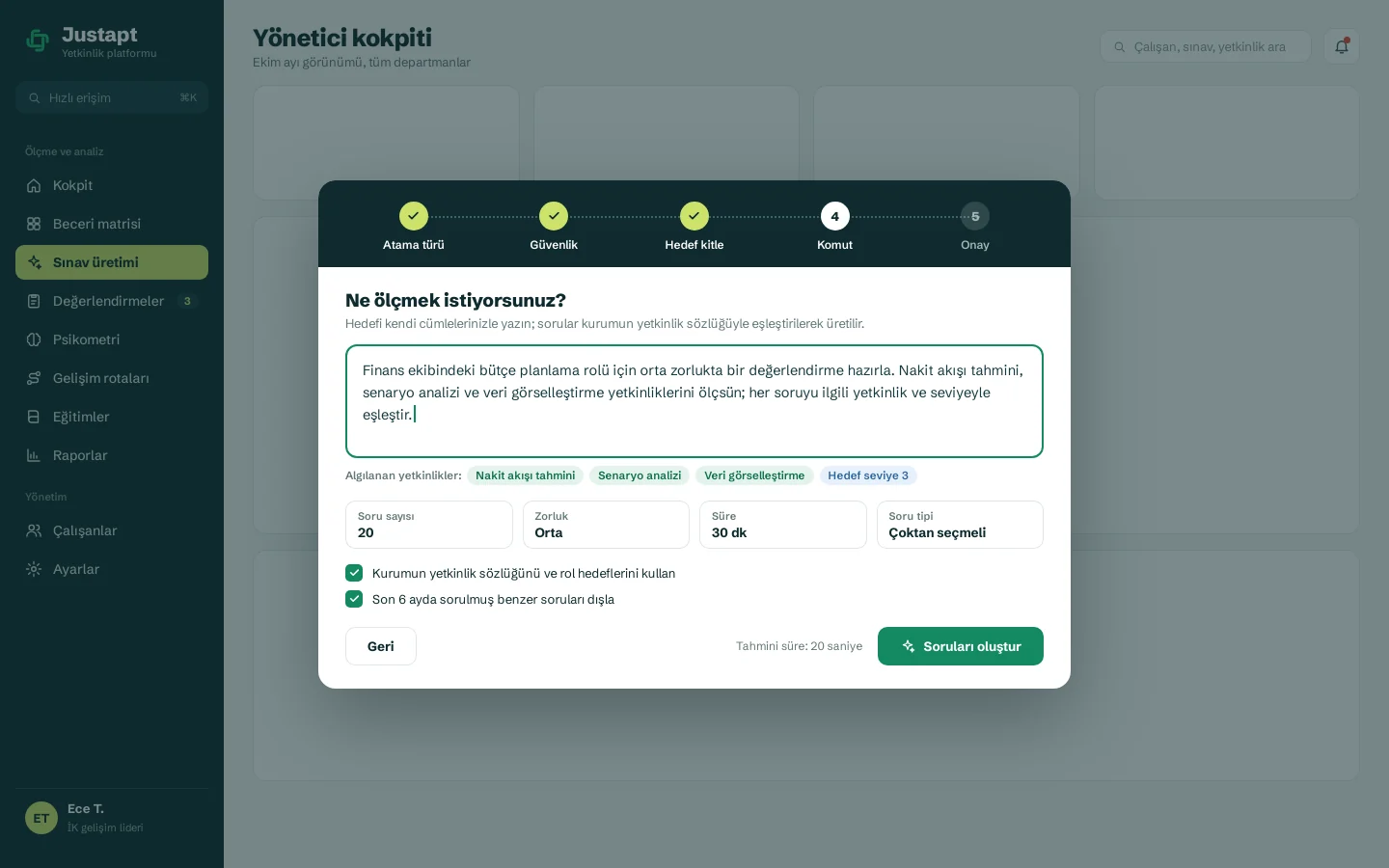
Exam generation proceeds through a five-step wizard: assignment type, security level, target audience, prompt and approval. In the prompt step, the manager writes what they want to measure in their own words. The system scans the competency dictionary, the role targets and the question pool; it detects the relevant competencies in the text and presents them to the manager together with the generation settings. Once approval is given, the questions, each tied to a competency and a level, are ready for review within seconds.
A question being tied to a competency may look like a detail, but all of the system's value comes from here. This is because the results later flow into the skills matrix, the career steps and the development paths through that link. A question that is not tied to a competency, however well written, adds nothing to the analysis.
The exam sits in the middle of a wider chain. Behind every step the user takes, there is work the system carries out: when the HR inventory is delivered, the organization matrix is built into the model, the topic and learning-outcome matching is aligned with the competency dictionary, and the exam is prepared with an adaptive design that selects questions by level. After the employee takes the exam, root competency analysis looks for the real cause of the gap, an individual development map is created and the final report, which has passed expert review, is published. In none of these eight steps is data moved by hand.
The expert has the last word before publication
A single wrong or ambiguous automatically generated question can make an entire assessment disputable. That is why the platform's basic rule is clear: questions are generated by AI but go live with expert approval. No question is published without approval.
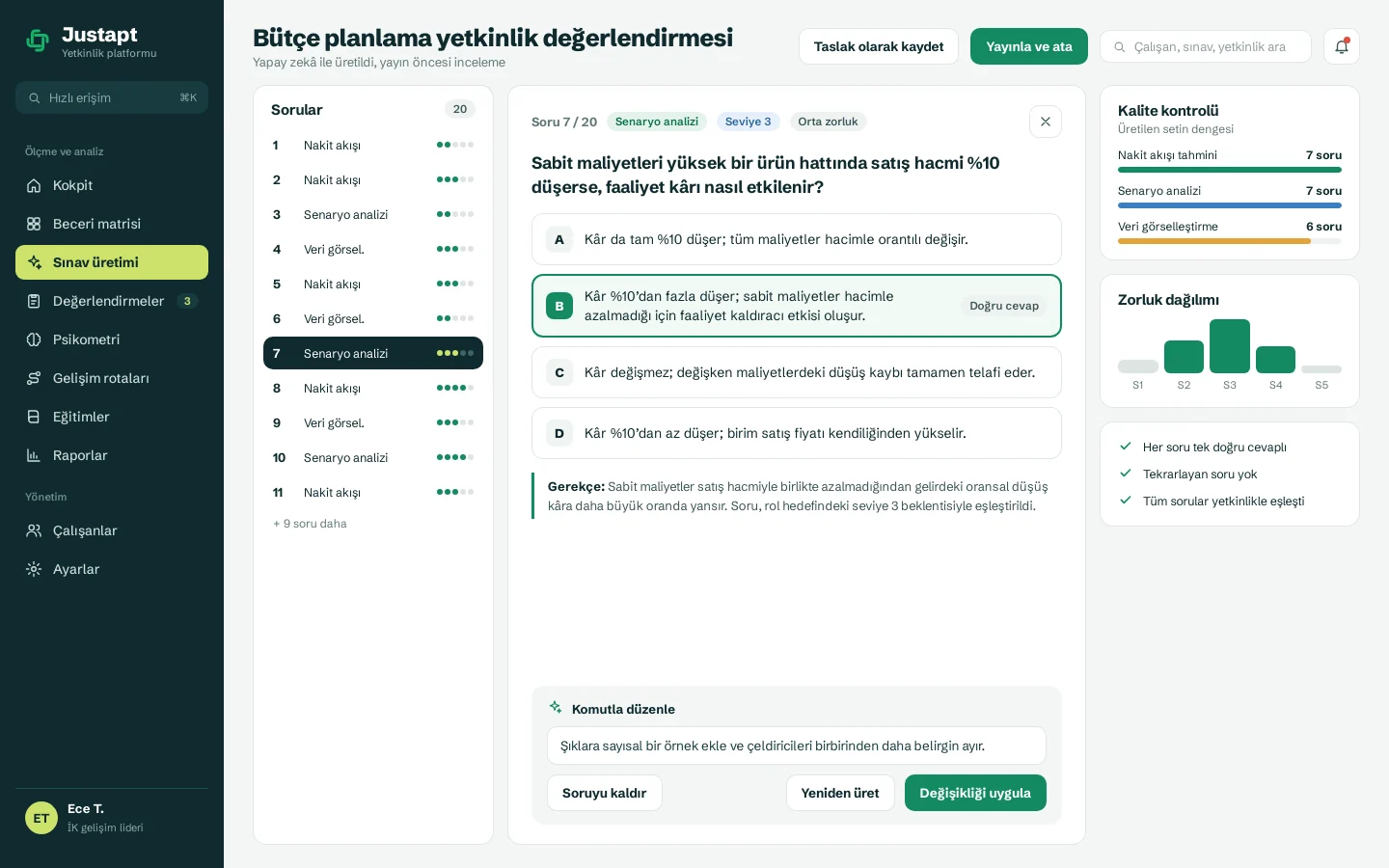
The expert reviews each question one by one in the question browser. Every question's correct answer is recorded along with its rationale and the level it measures; the rationale also states which level expectation in the role target the question was matched to. A question the expert is not satisfied with is edited with a prompt given in natural language; the answer options, the difficulty or the context are updated with this instruction. If needed, the question is regenerated or removed from the set.
A quality control panel runs on the same screen. For every set, the checks for competency distribution, difficulty balance, a single correct answer and duplicates are reported automatically. This panel is critical so that the expert, while focused on a single question, does not lose sight of the picture for the whole set. When the set is ready, the expert can save it as a draft or publish it and assign it to the target audience in a single step.
Taking the exam: flexible or proctored?
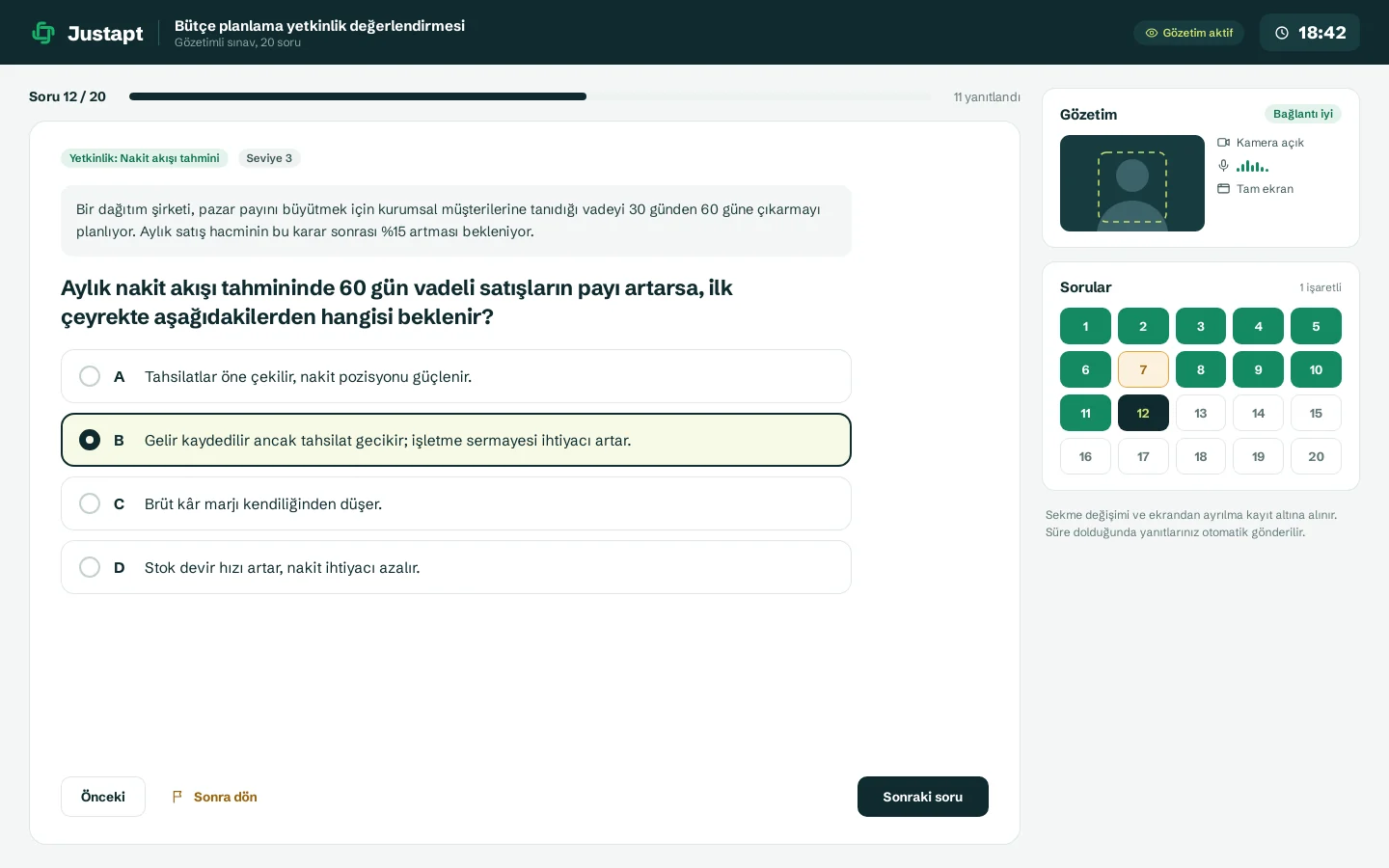
The integrity of the exam also had to be adjustable to its purpose. In critical decisions such as promotion and hiring, results need to be protected against cheating and outside help; in development-oriented measurements, the same strictness creates unnecessary friction. That is why the security level is one step of the wizard: flexible mode, or proctored mode with camera, microphone, full screen and tab tracking. Tab switching, leaving the screen and time-outs are handled automatically.
On the employee's side the screen is simple: a time counter, a question map and a single question in front of them. Like the rest of the platform, the screen was designed to meet the WCAG 2.1 AA accessibility criteria and to be screen-reader friendly. Every answer is written to the server instantly; no answer is lost even if the connection drops. The exam can also take shape according to the candidate's answers: a candidate who answers a medium-level question correctly may get a harder question at the next step. Results are reflected automatically in the skills matrix and the career steps. In the report, questions are also separated by type: general competency, strategic thinking, problem-solving and analytical thinking questions are evaluated separately, and success by difficulty level is shown as well. Alongside knowledge exams, personality, resilience and cognitive ability scales are administered on the same platform; because their scoring logics differ, they are calculated with separate algorithms and combined in a single candidate report.
What we learned in the field
- AI speeds things up; the expert decides. Automating generation while tying publication to approval preserved both speed and trust.
- Every question should be tied to a competency. A question linked to the dictionary keeps producing value after the exam too.
- The rationale is part of the question. Recording why the correct answer is correct and which level it measures makes review easier.
- Security should be proportionate to the purpose. Flexible mode for development measurement, proctored mode for critical decisions; both on the same platform.
An assessment is only as valuable as its weakest question. The right way to use AI is to build, at the same time, the process that catches that weak question before it goes live.
How long does it take to prepare your assessments?
If preparing assessments takes your expert teams weeks, or if you have a process where you want to use AI but hold back for fear of losing control, we can design a human-approved generation flow together. You can take a look at the JustApt project page or get in touch with us.
About the author
Selin Kaya
Digital Content Specialist
As a digital content specialist at Karatsoft, she prepares the blog articles. She explains in plain language what the products and projects are for and how they are used.



Comments
0No comments yet. Be the first to comment!
Leave a Comment
Feel free to share your thoughts and feedback with us.