Skip to content
Project
  • Web

JustApt

Competency Measurement and Development Platform

An end-to-end platform developed for an organization with thousands of employees that brings AI-powered exam generation, psychometric measurement, competency analytics, and training management together under one roof.

  • HR systems
  • Identity systems
  • ERP
  • CRM
JustApt - Competency Measurement and Development Platform showcase image

Project Summary

JustApt is an AI-powered competency measurement and development platform built for a large-scale organization. It measures employees’ technical and behavioral competencies, shows the gap between their level and the level their role expects, and automatically builds the development path that will close that gap.

The platform brings four engines together under one roof: AI-powered exam generation, psychometric measurement, competency analytics, and learning management (LMS). Managers, instructors, and employees work on the same data model, but each sees an interface focused only on their own work. The system connects to the organization’s HR, identity, and organization systems through APIs. The architecture was built with KVKK (the Turkish Personal Data Protection Law) and GDPR requirements in mind.

Your next transformation

Let's plan a similar transformation for your operations

Tell us what you need; we'll set out the scope, integrations and roadmap in writing in the first meetings. Built around the way you work, without touching your ERP, accounting or banking systems.

  • Written scope and roadmap
  • Integrated with your existing systems
  • Post-launch support from the same team
Explore other projects
Project details

A closer look at the JustApt screens

The main screens and their highlights: on every image we magnify the area that matters most. Tap an image for details.

Manager cockpit

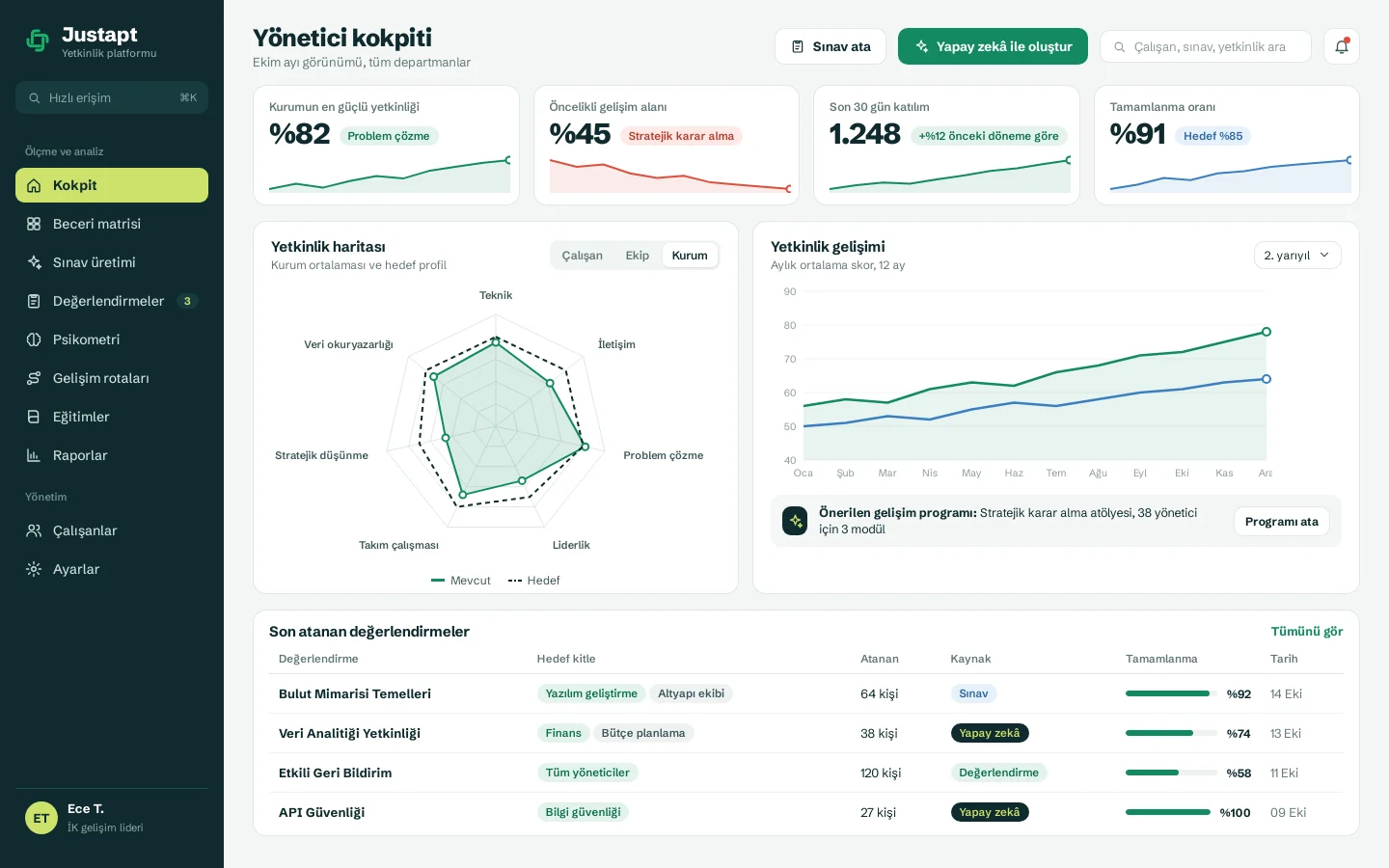
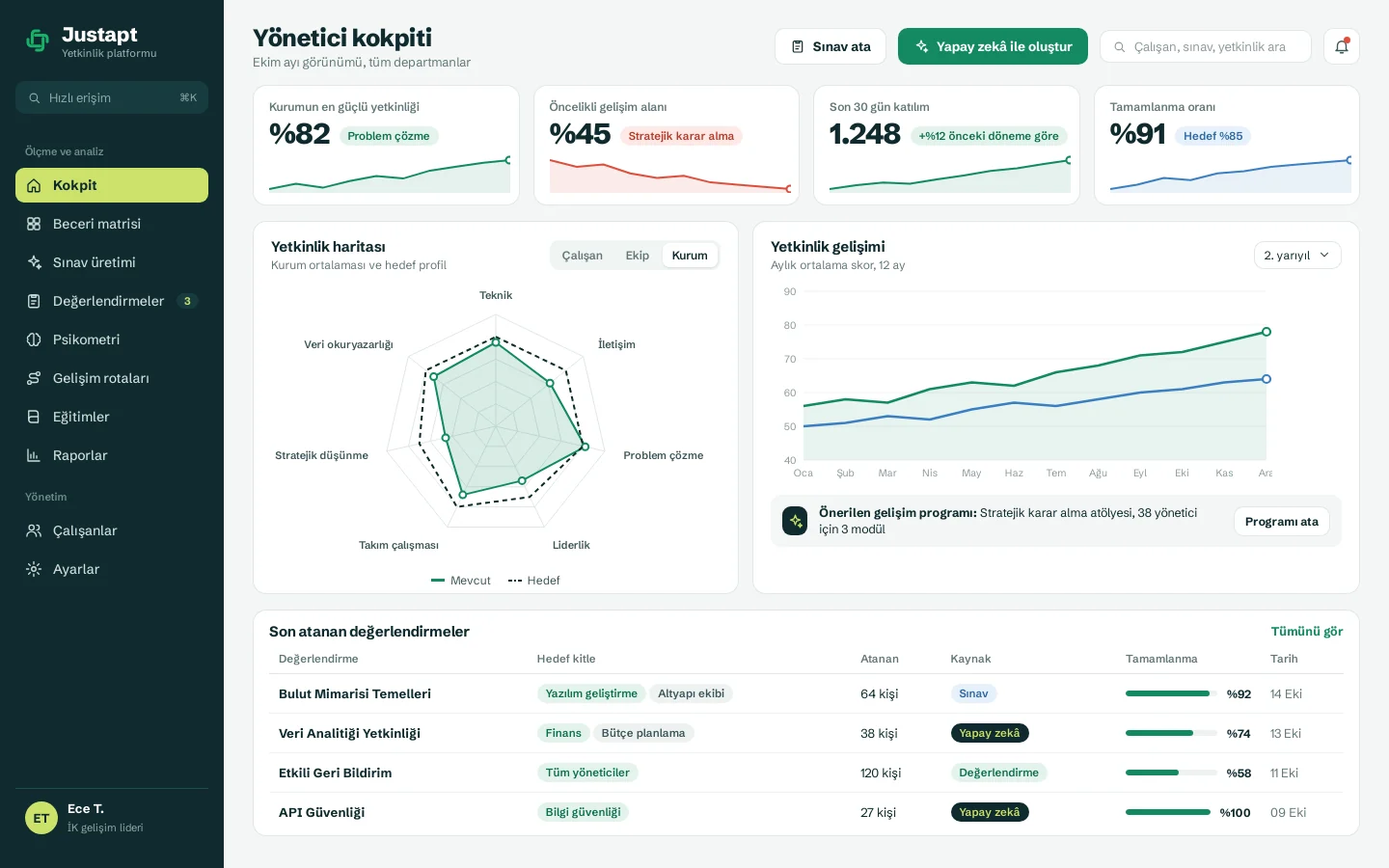
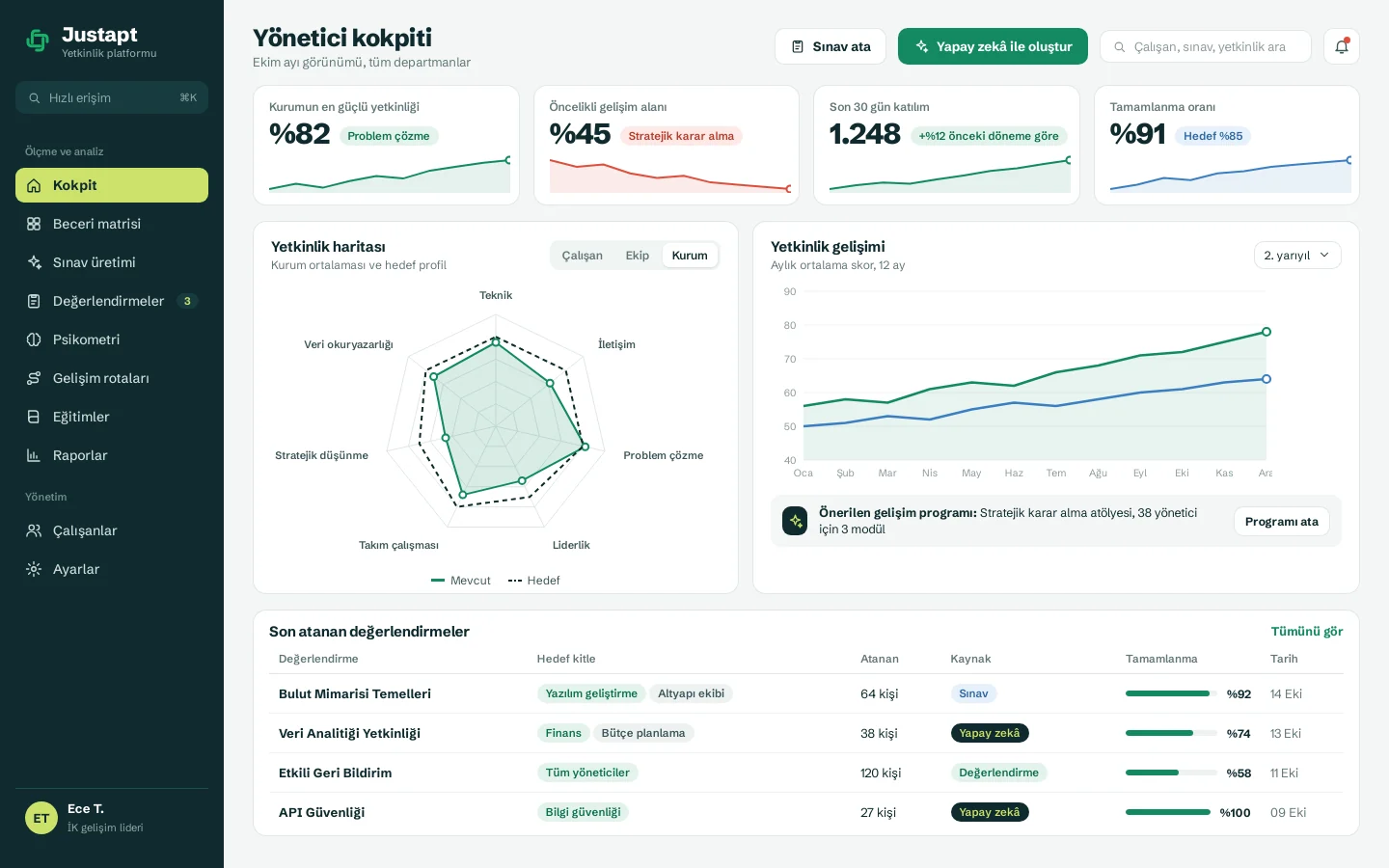
Managers and the HR team see the organization’s competency status on a single screen: the cards at the top show the strongest competency, the priority development area, participation, and the completion rate. The competency map compares the current profile with the target profile at the employee, team, and organization level; the 12-month trend, the recommended development program, and the most recently assigned assessments are on the same page.

Manager cockpit

Skills matrix and gap analysis

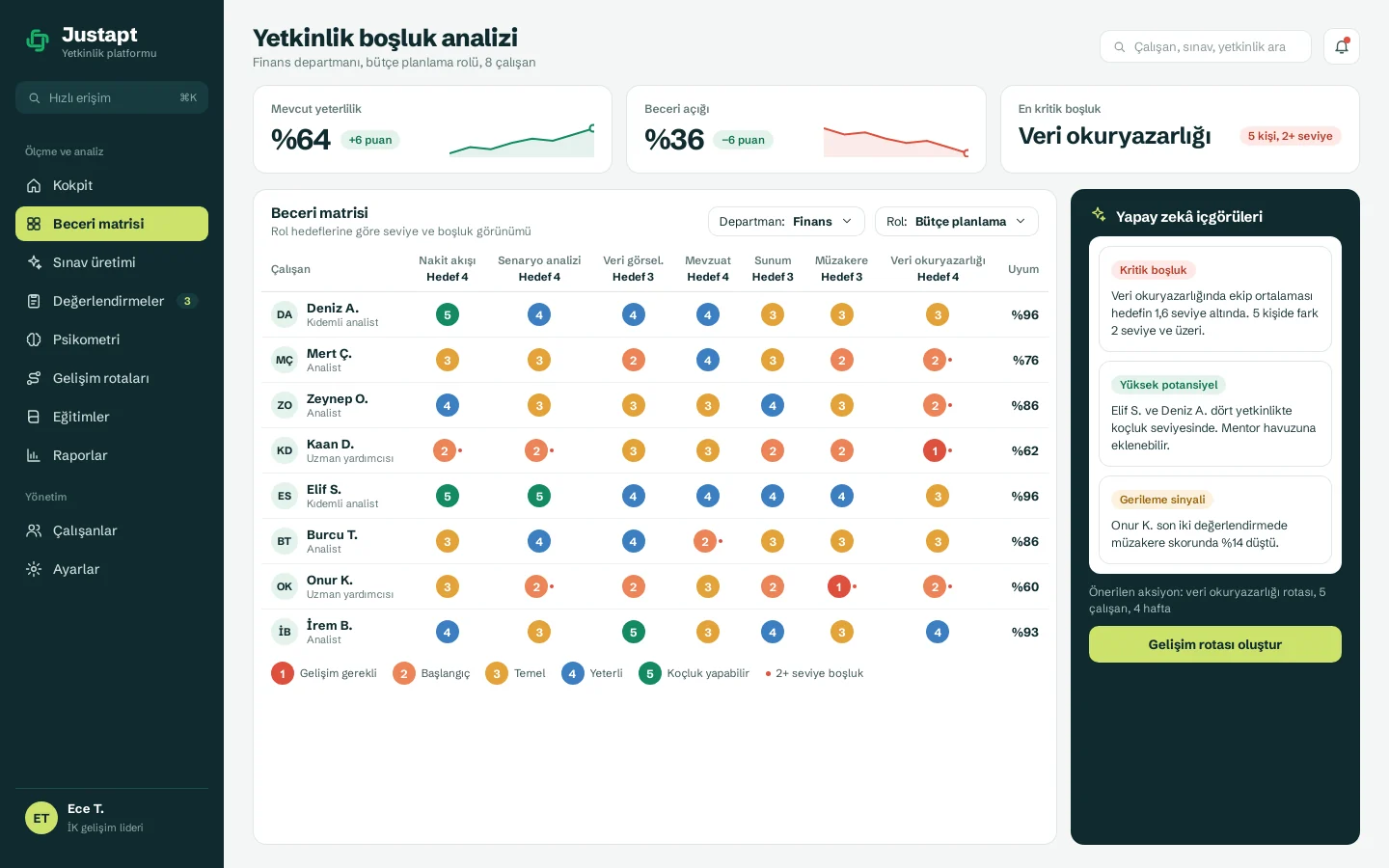
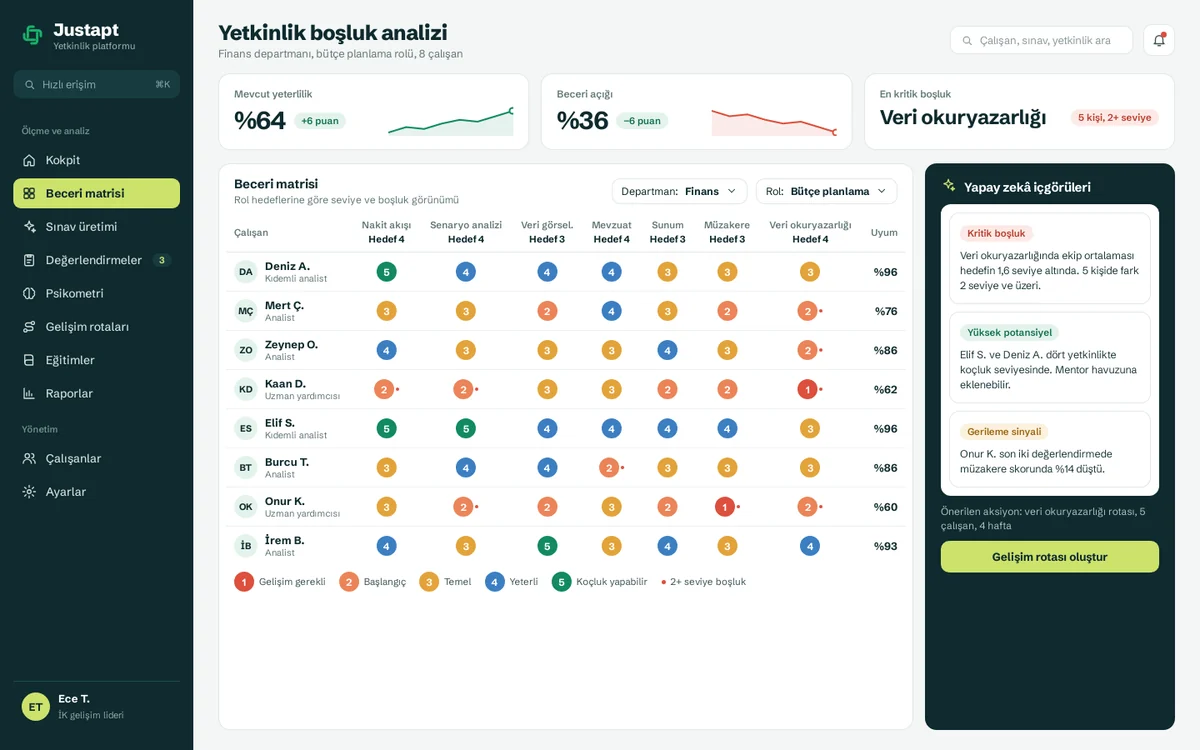
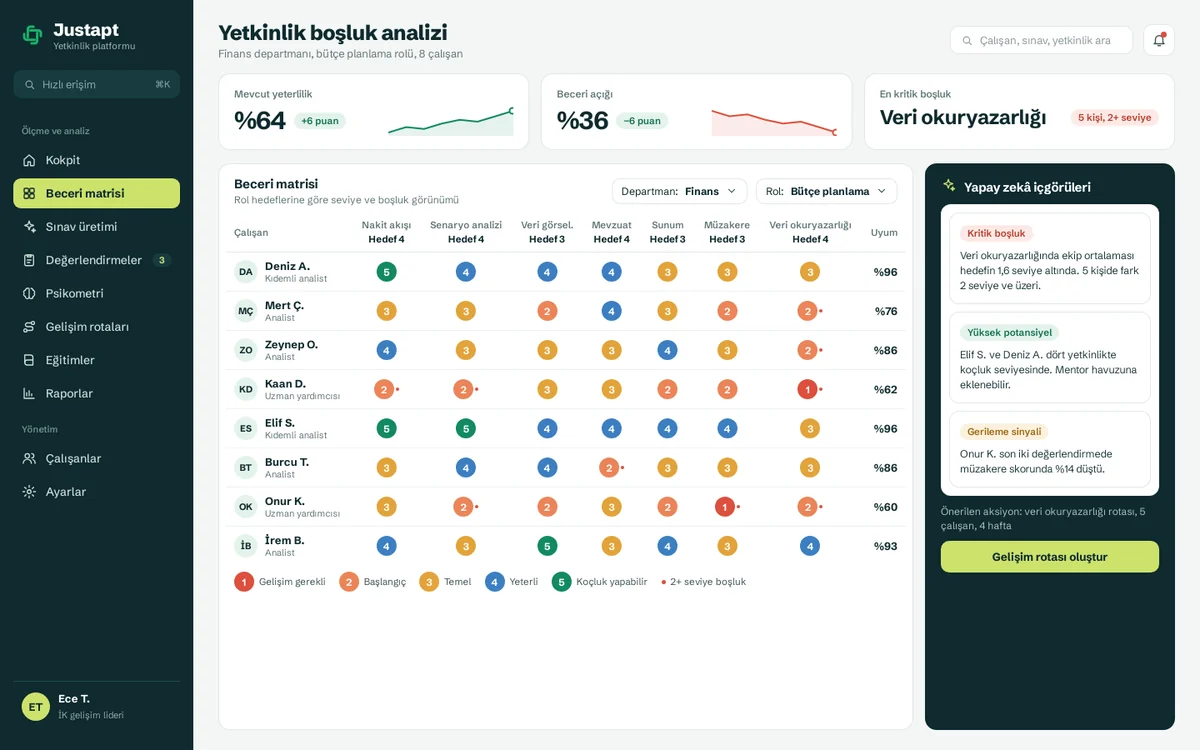
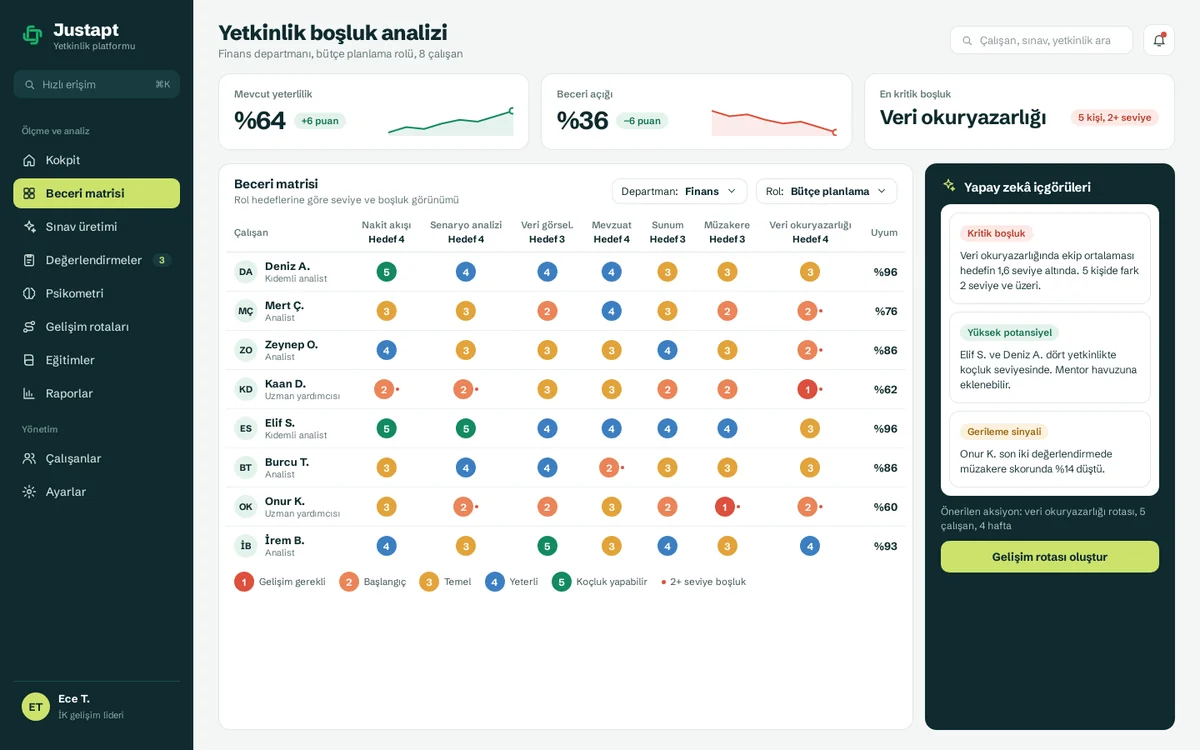
When a manager selects the department and role, target levels are loaded into the matrix; each employee’s level in each competency sits next to the role target. A gap is measured not by color but by level difference, and differences of two or more levels are flagged separately. The AI panel on the right highlights the critical gap, high-potential employees, and signs of decline.

Skills matrix and gap analysis

AI-powered exam generation

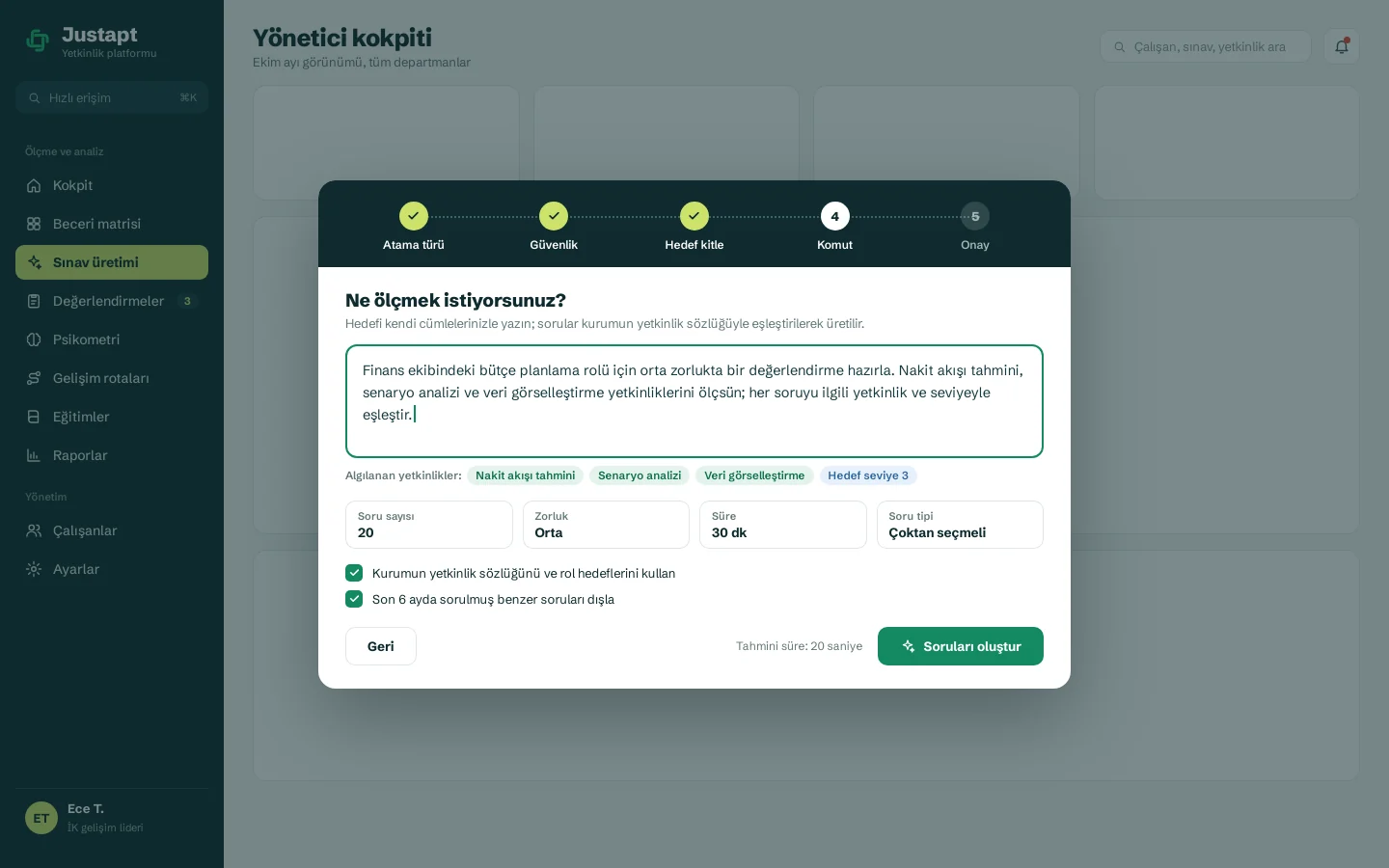
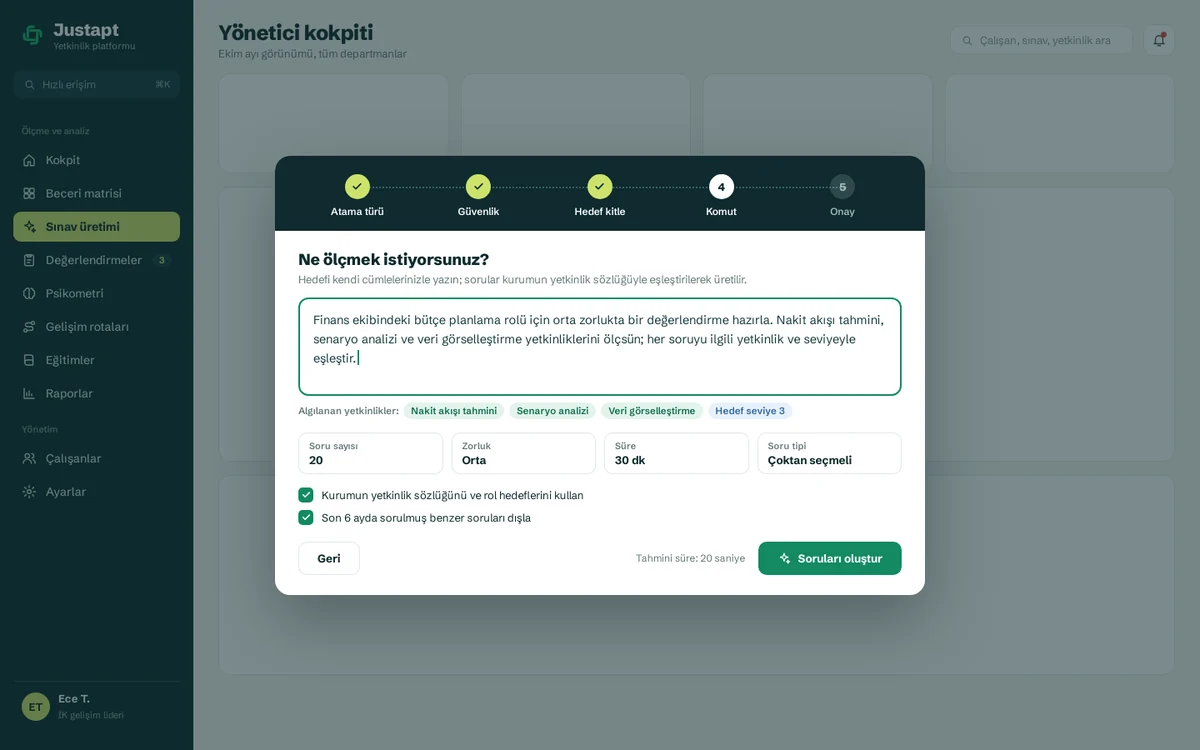
In a five-step wizard, the manager selects the assignment type, security level, and target audience, then writes what they want to measure in their own words. The system detects the relevant competencies and target level from the text and presents them together with settings for question count, difficulty, duration, and question type. Questions are generated to match the organization’s competency dictionary and role targets.

AI-powered exam generation

Question preview and editing by prompt

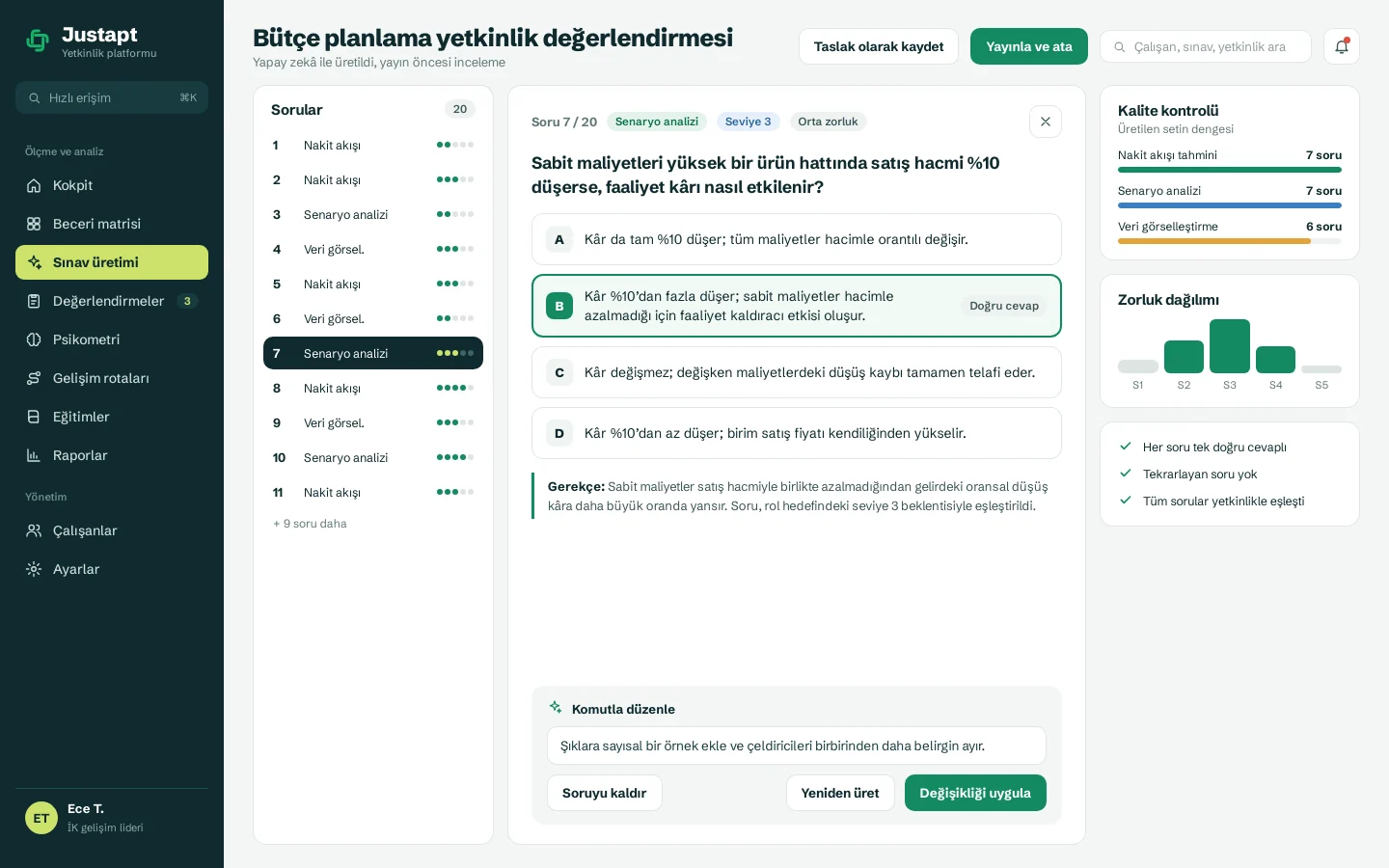
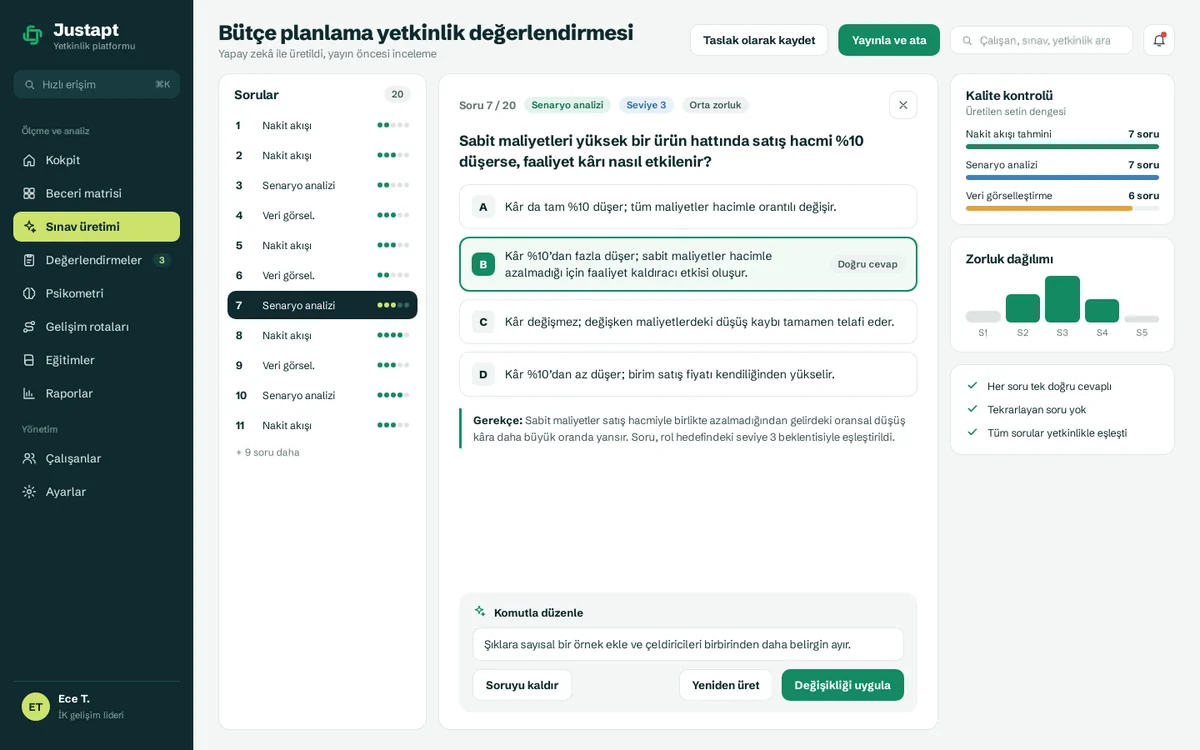
Before publication, the questions generated by AI come before the expert on this screen. In the question explorer, each question opens with its competency, level, and difficulty; the correct answer is shown together with its rationale. The expert edits a question they are not happy with using a prompt in natural language, has it regenerated, or removes it; the right-hand panel reports quality control and the difficulty distribution.

Question preview and editing by prompt

Proctored exam experience

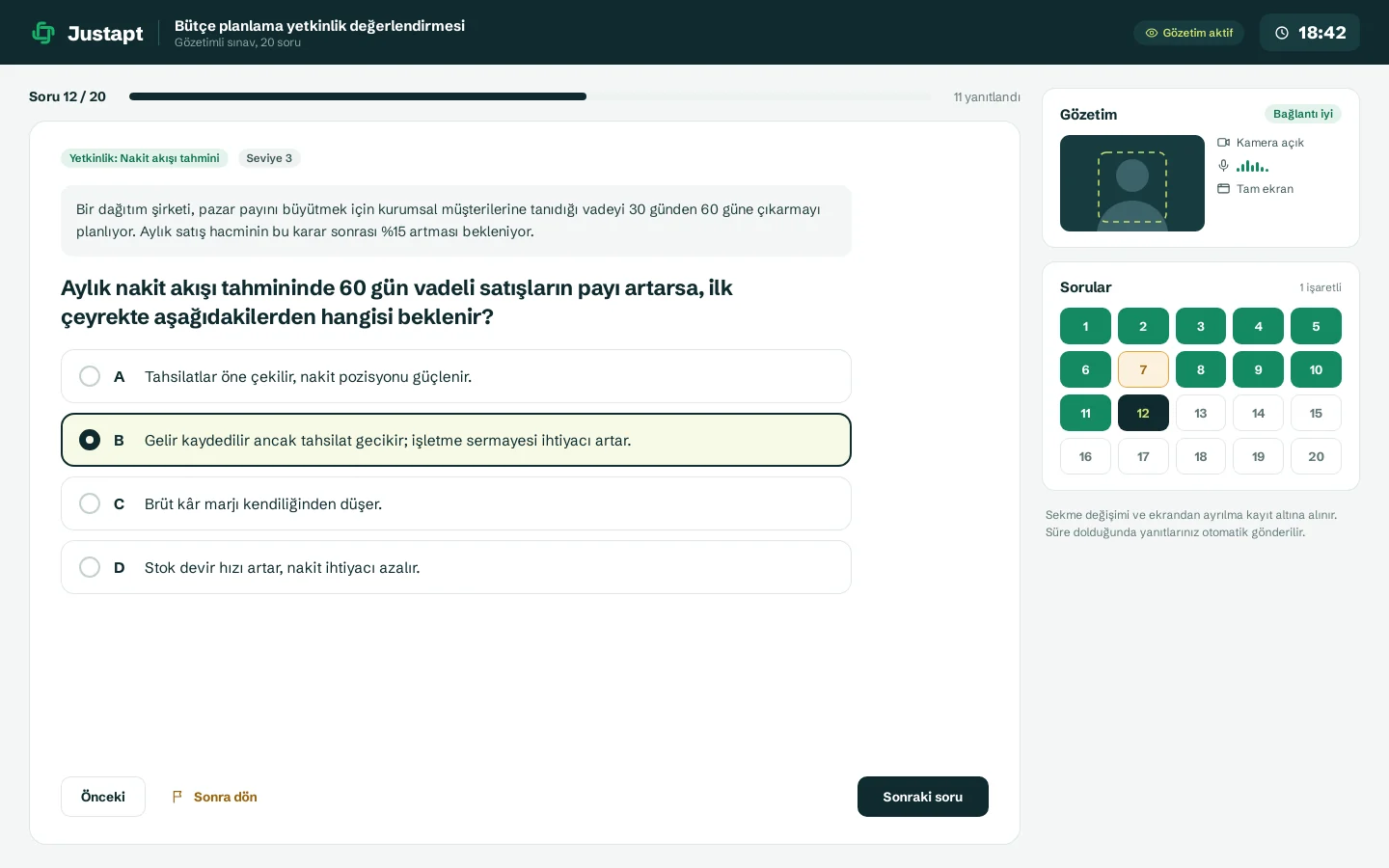
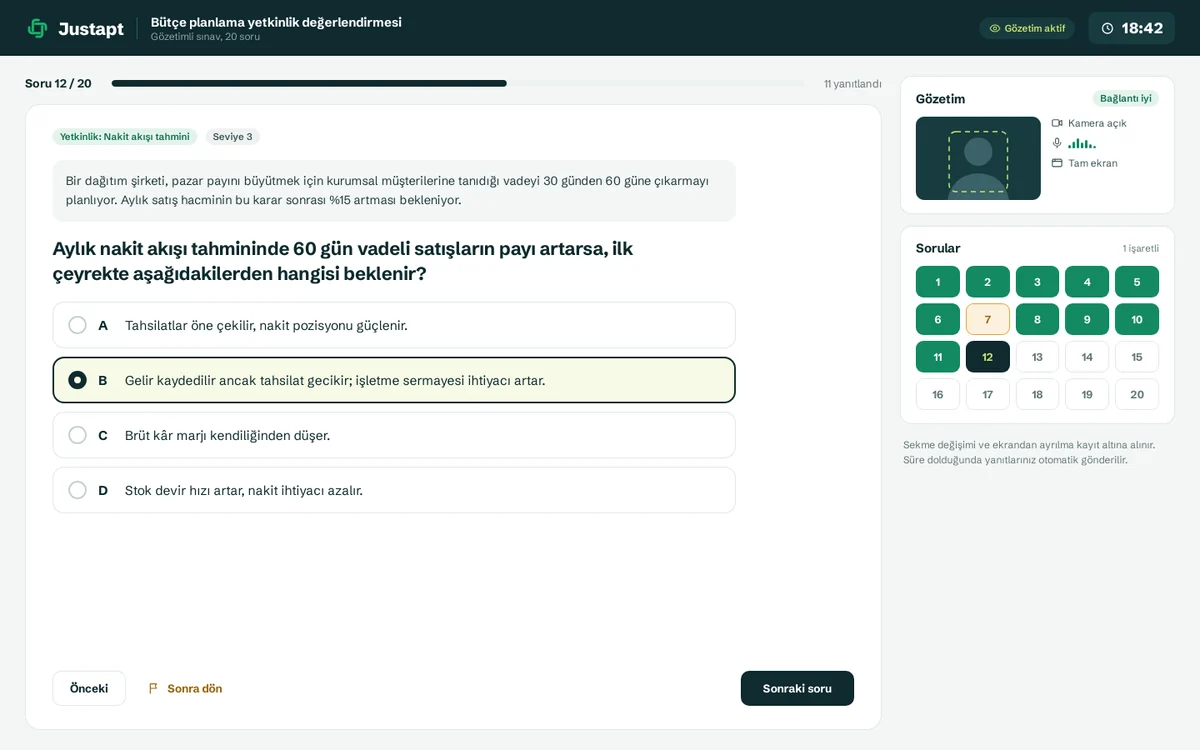
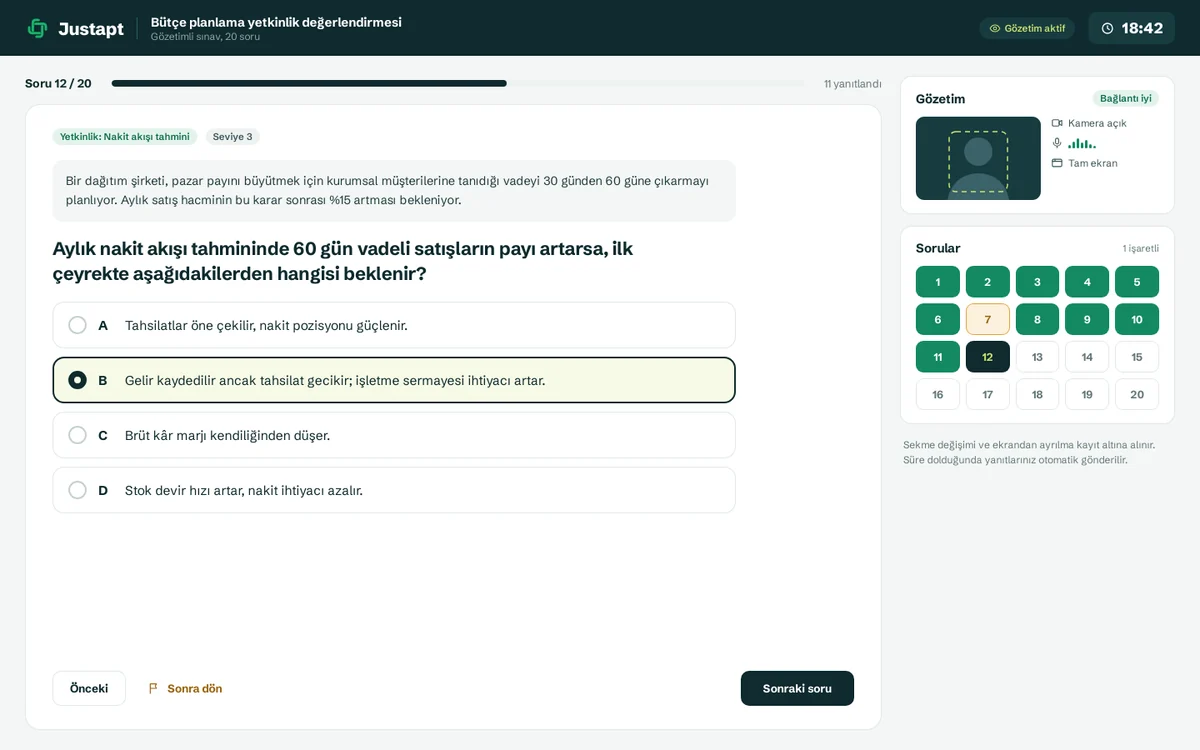
Employees answer the exam on a clean screen: a countdown timer and a progress bar at the top, and on the right a question map showing answered and flagged questions. In proctored mode, the camera, microphone, and full-screen status appear in the proctoring panel, and tab switching is logged. Every answer is written to the server instantly; no answer is lost even if the connection drops.

Proctored exam experience

Psychometric measurement center

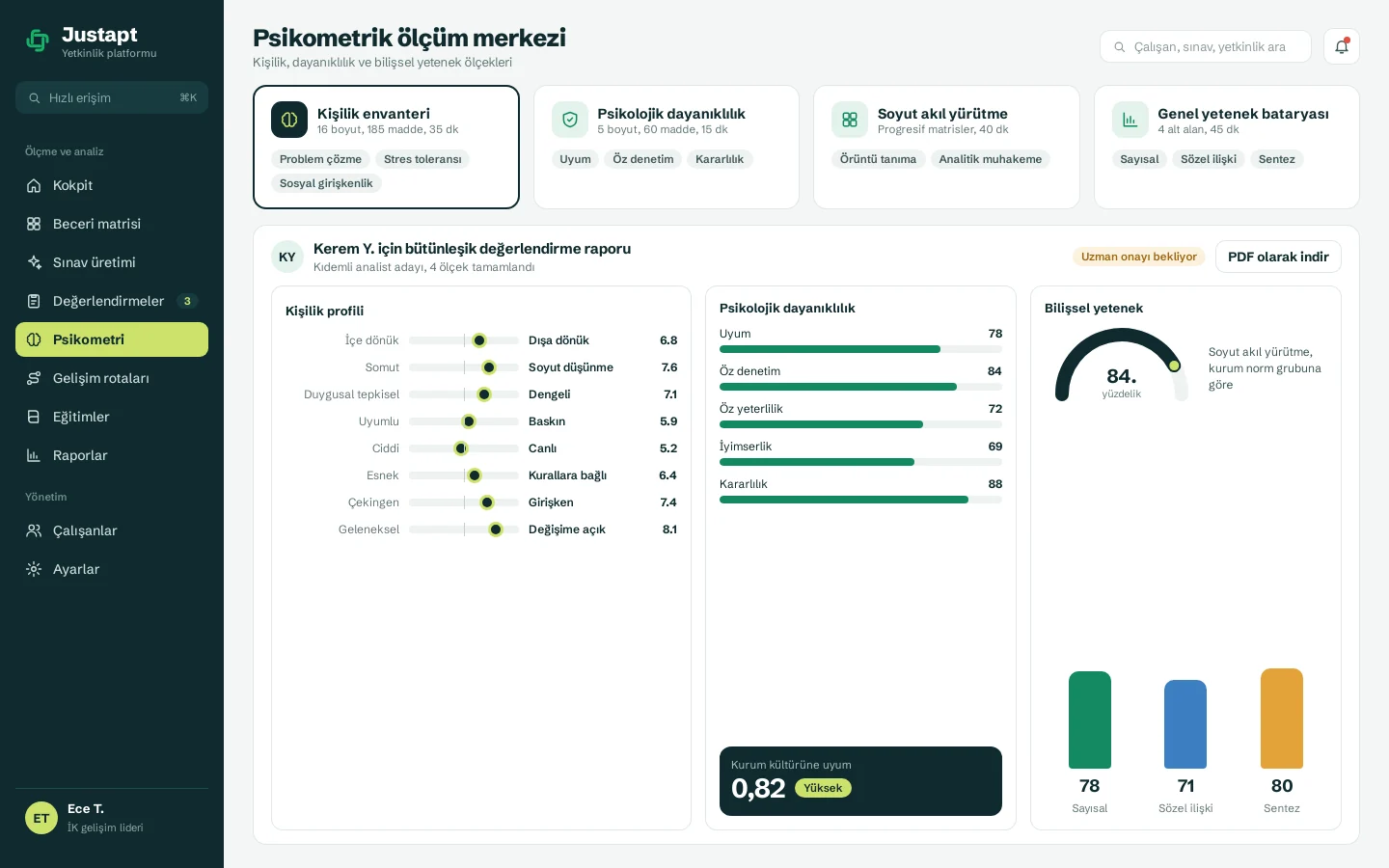
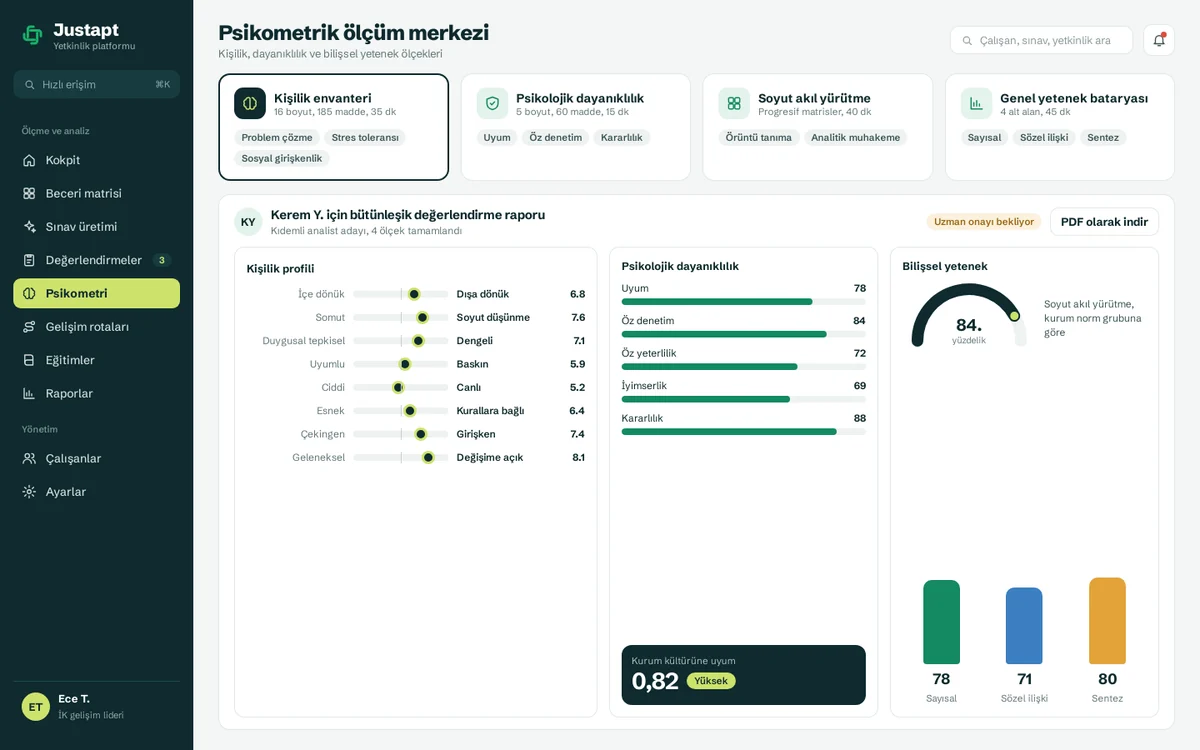
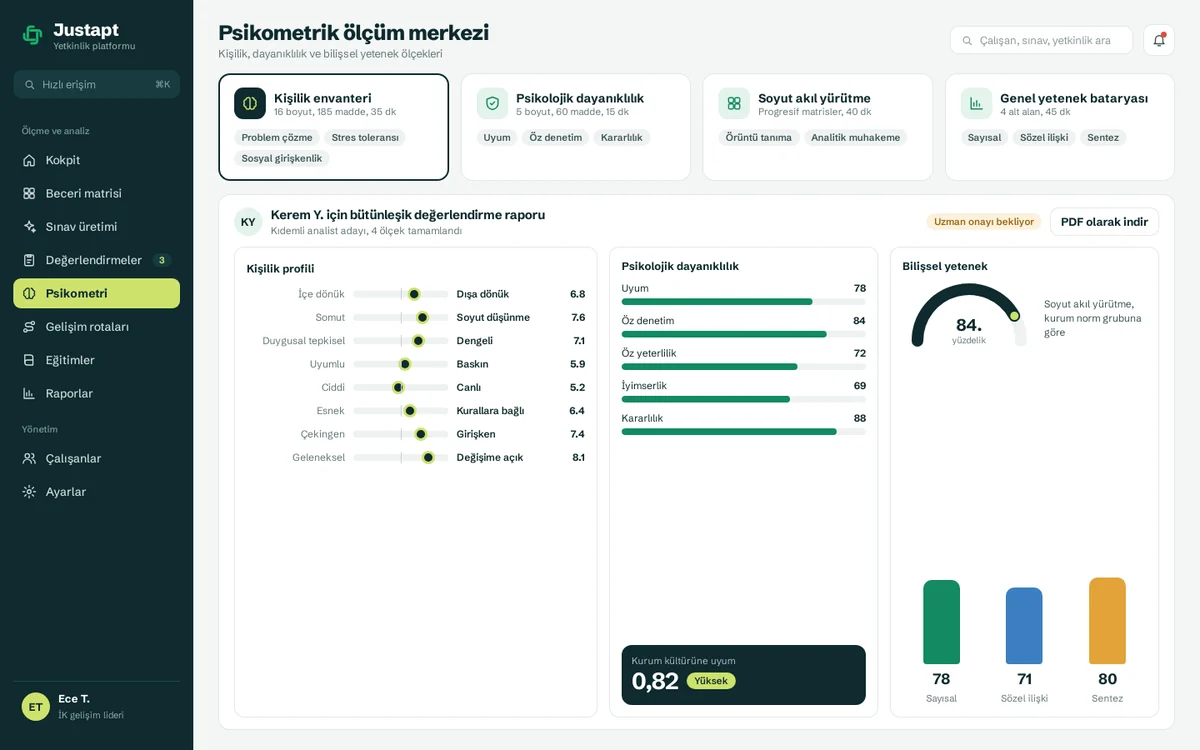
Alongside knowledge exams, a personality inventory, psychological resilience, abstract reasoning, and a general ability battery run in the same center. Each scale is calculated with its own scoring algorithm; the results are combined in a single candidate report with the personality profile, resilience sub-dimensions, and cognitive ability indicators. The report is published after approval by the subject-matter expert.

Psychometric measurement center

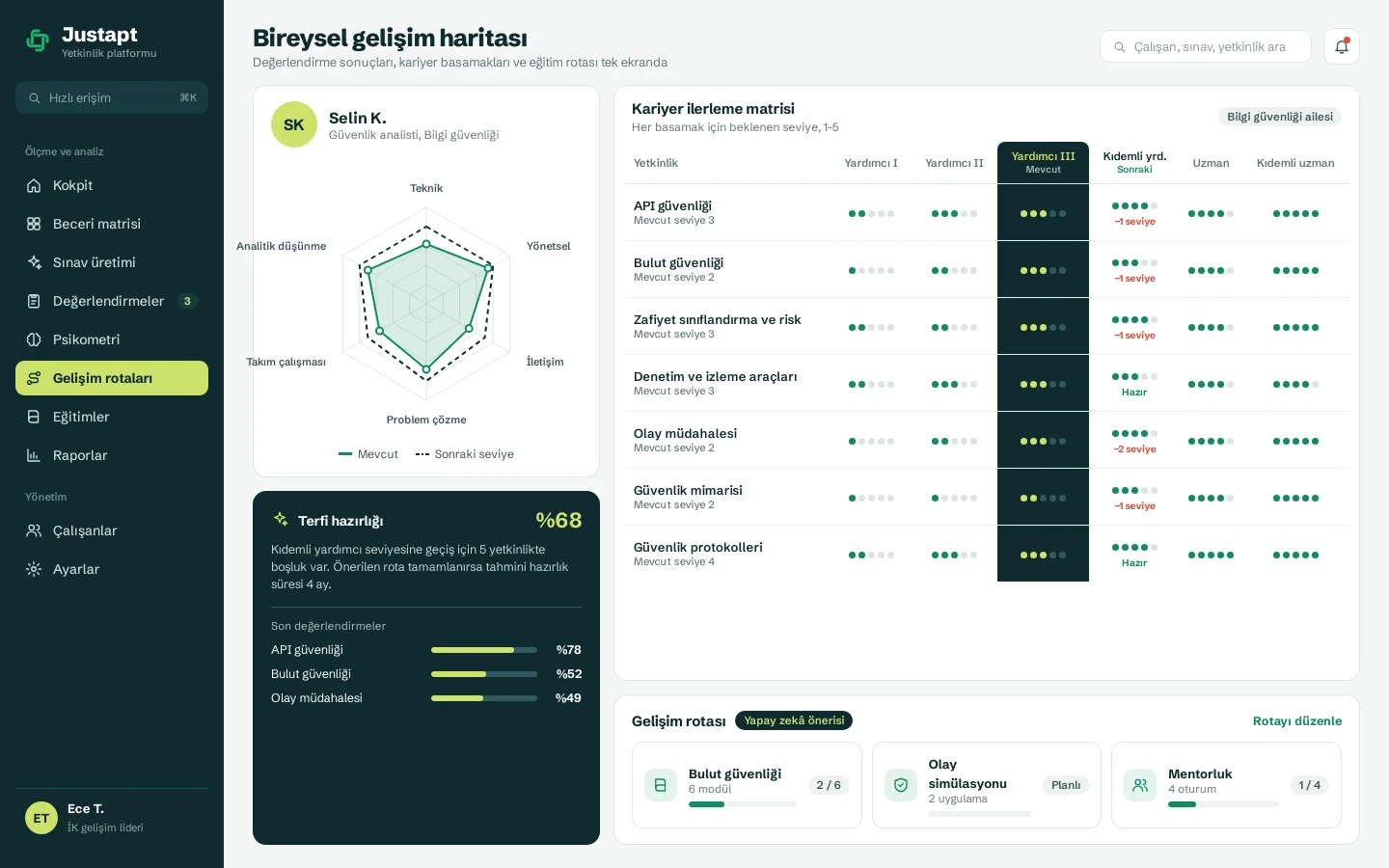
Individual development map and career matrix

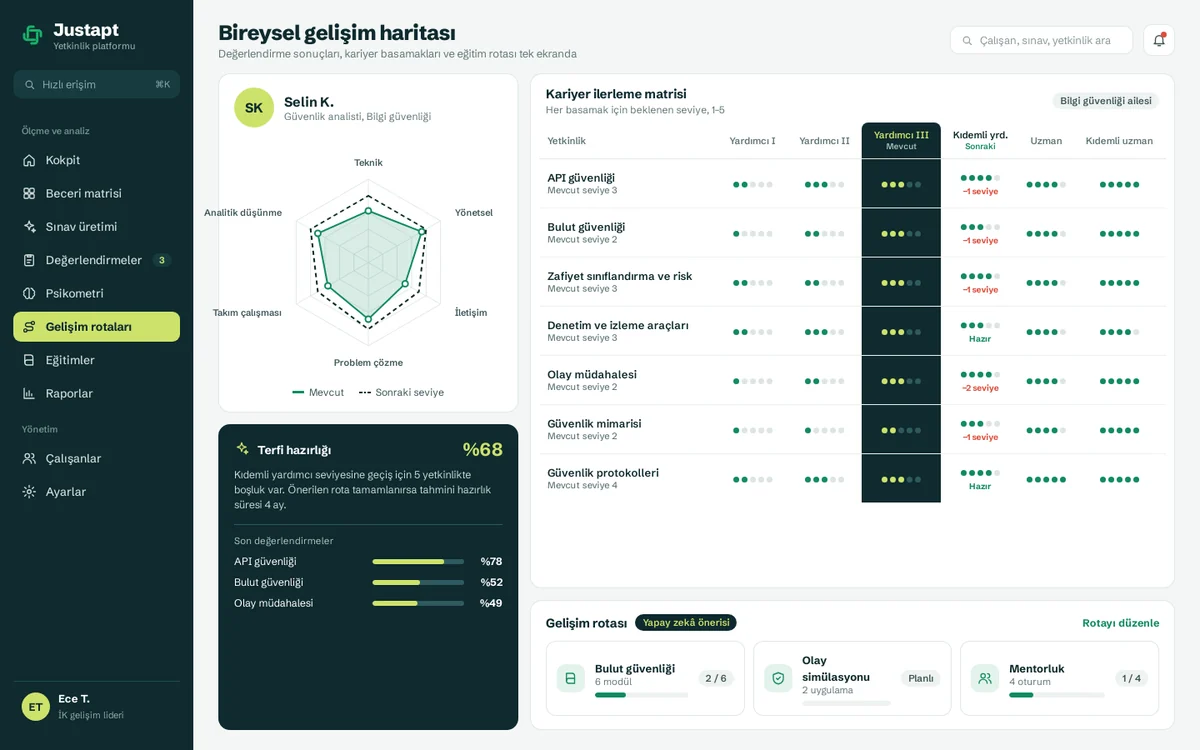
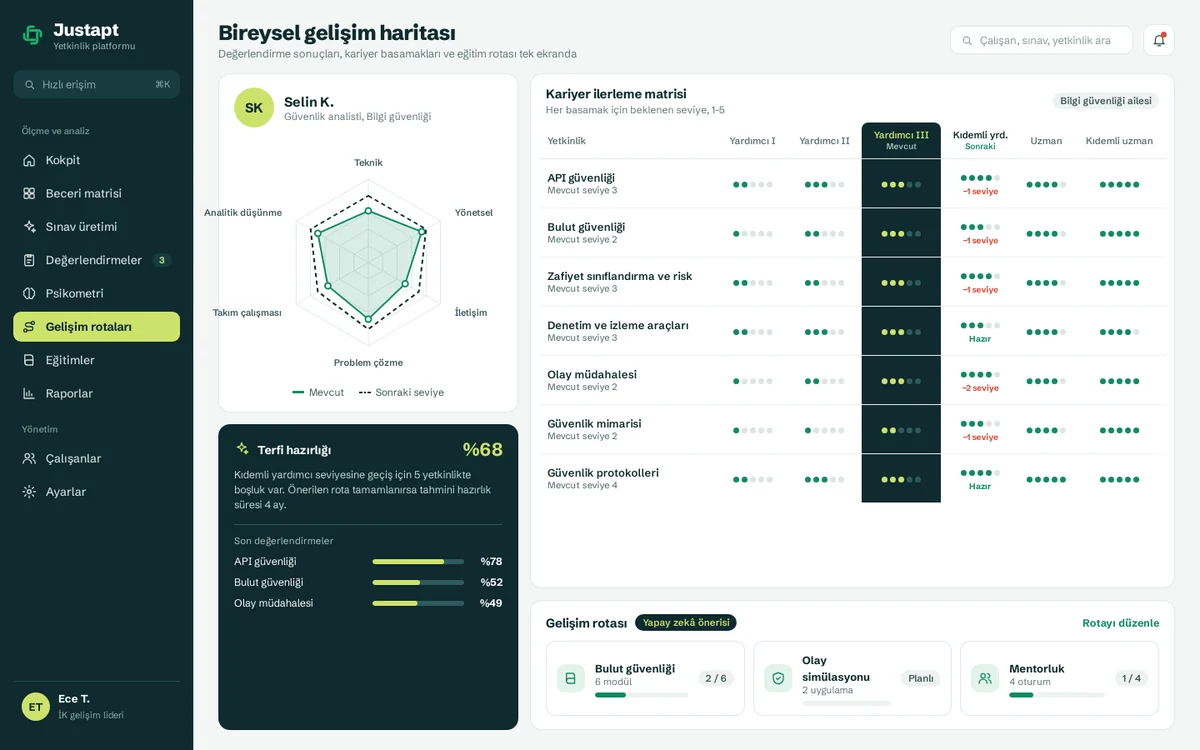
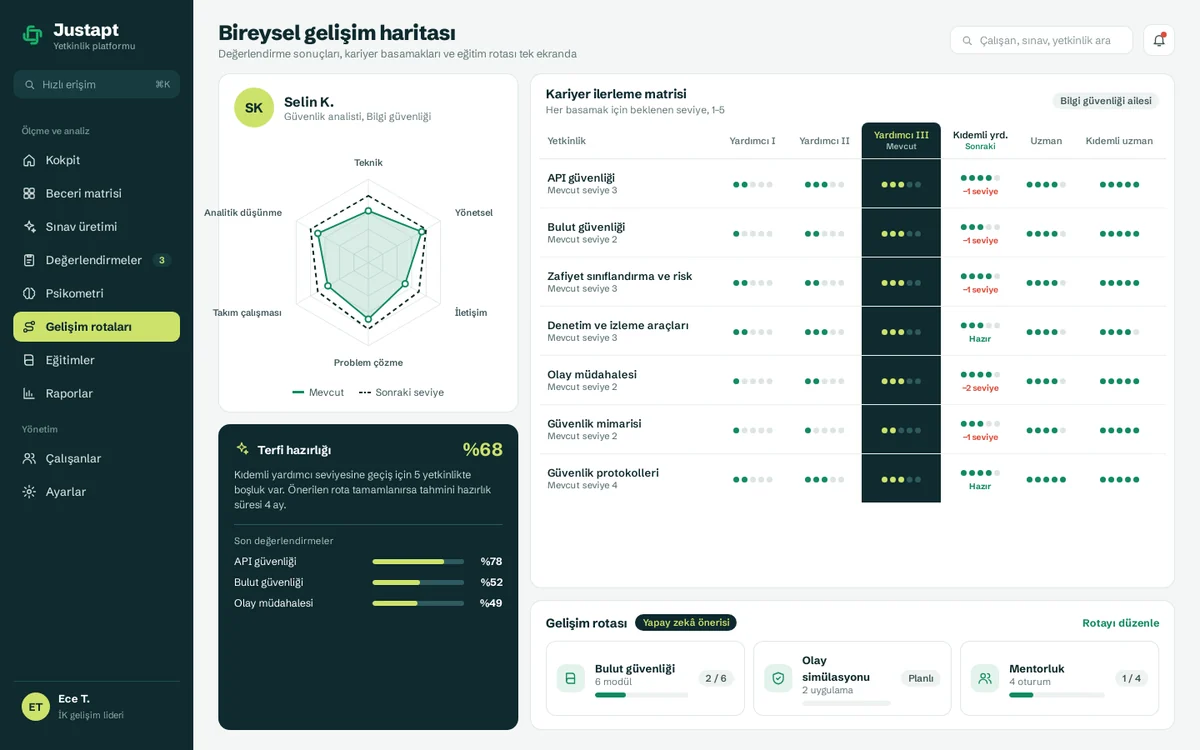
Assessment results are matched to career steps automatically. For each competency, the career progression matrix places the level a step expects next to the person’s current level; how many levels are missing for the next step is visible row by row. Promotion readiness and the recommended development path are on the same page; employees also see this information in their own area.

Individual development map and career matrix

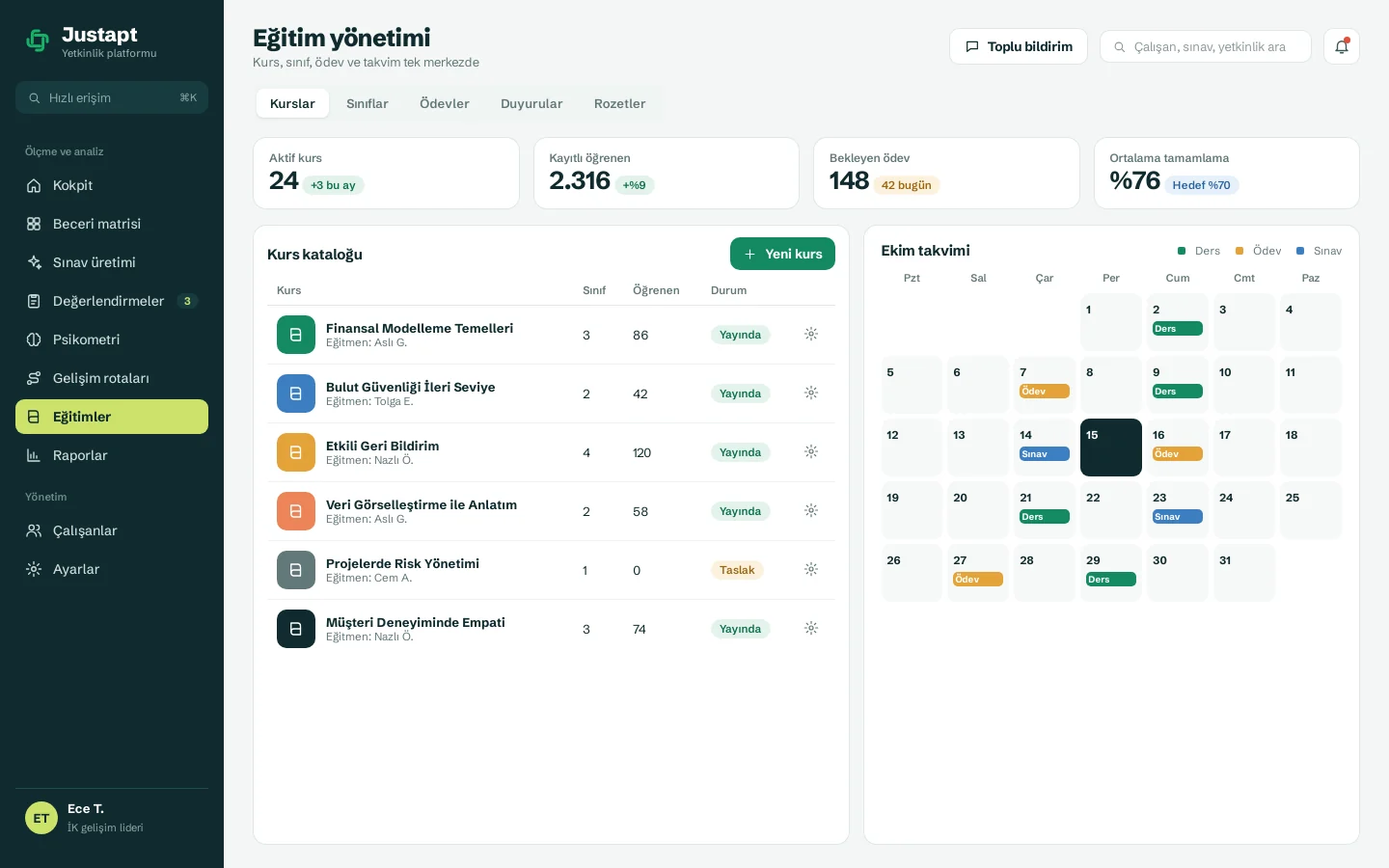
Training management

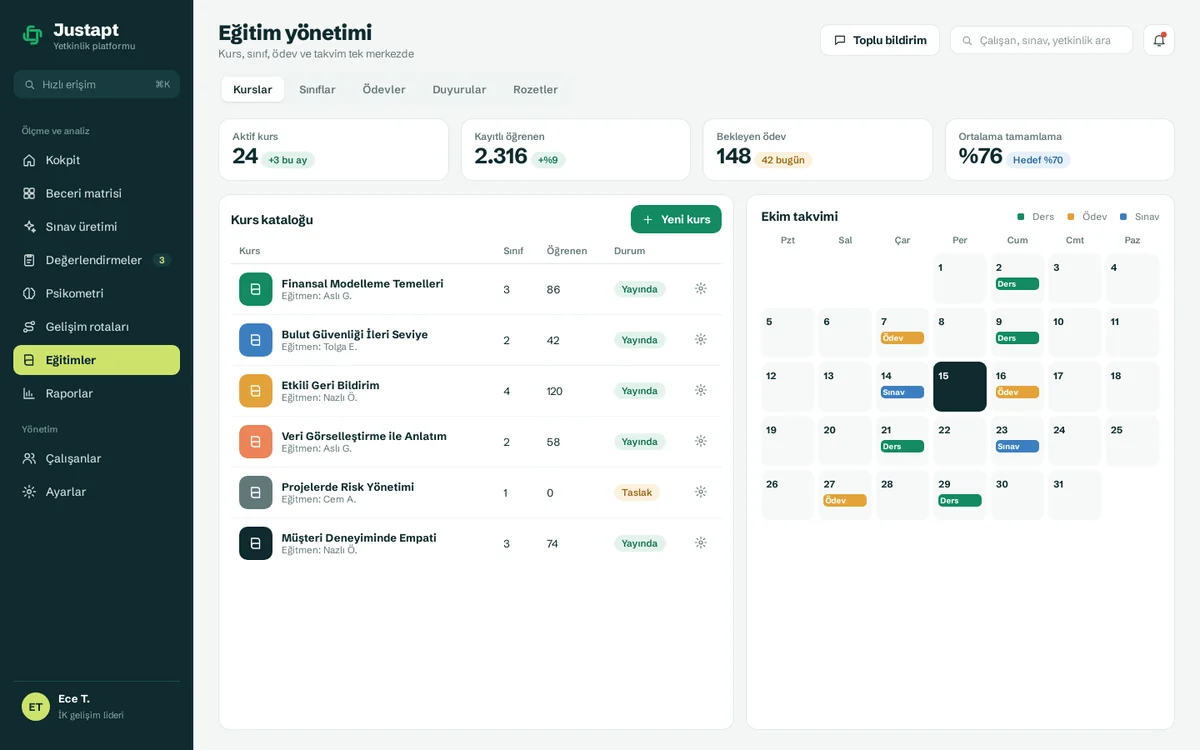
After measurement, development continues on the same platform. Instructors and the HR team manage the course catalog, classes, assignments, announcements, and badges from a single center; each course’s class count, learner count, and publishing status are visible in the catalog. The monthly calendar separates lessons, assignment submissions, and exams by color; bulk notifications go out with a single button.

Training management

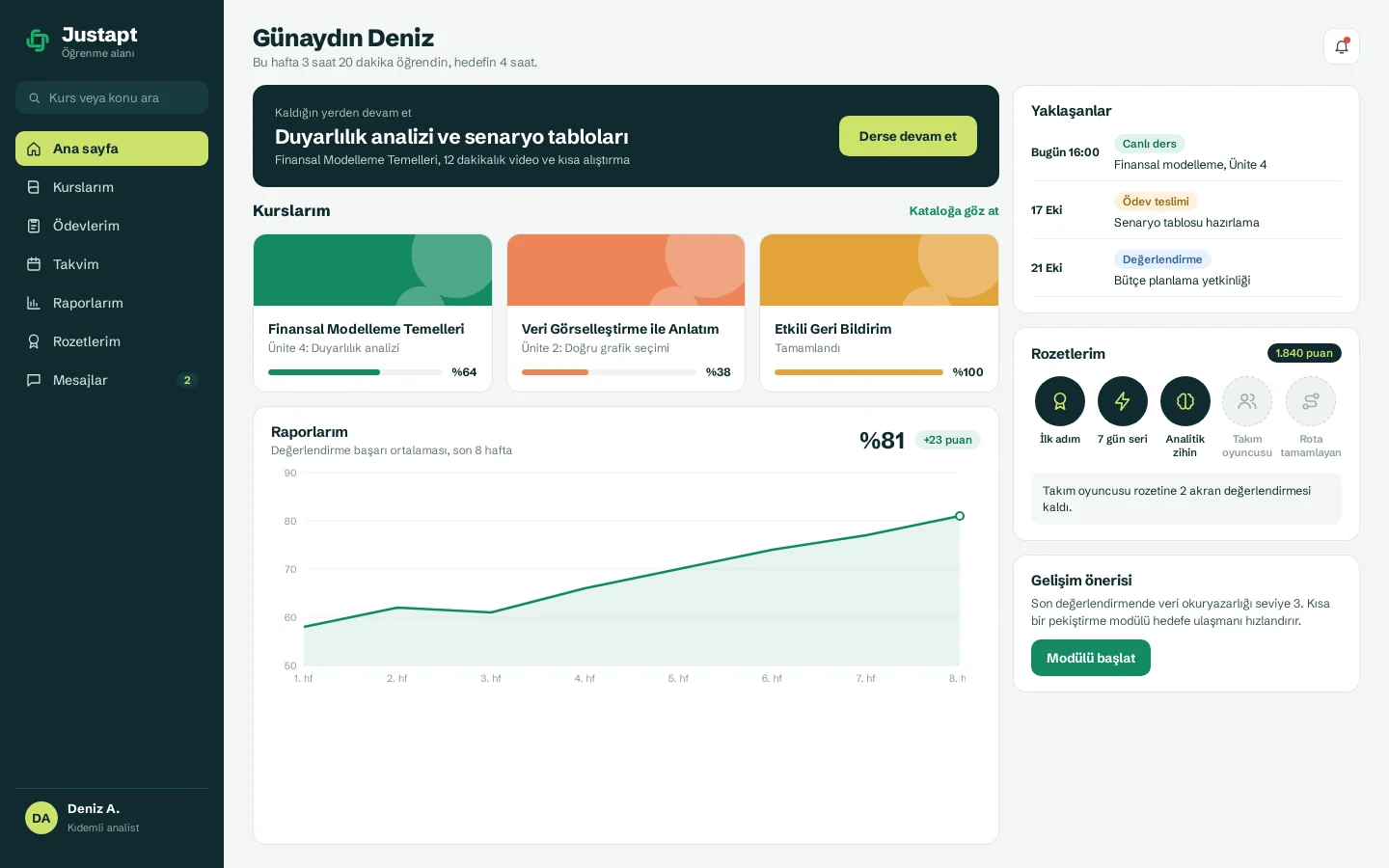
Learner area

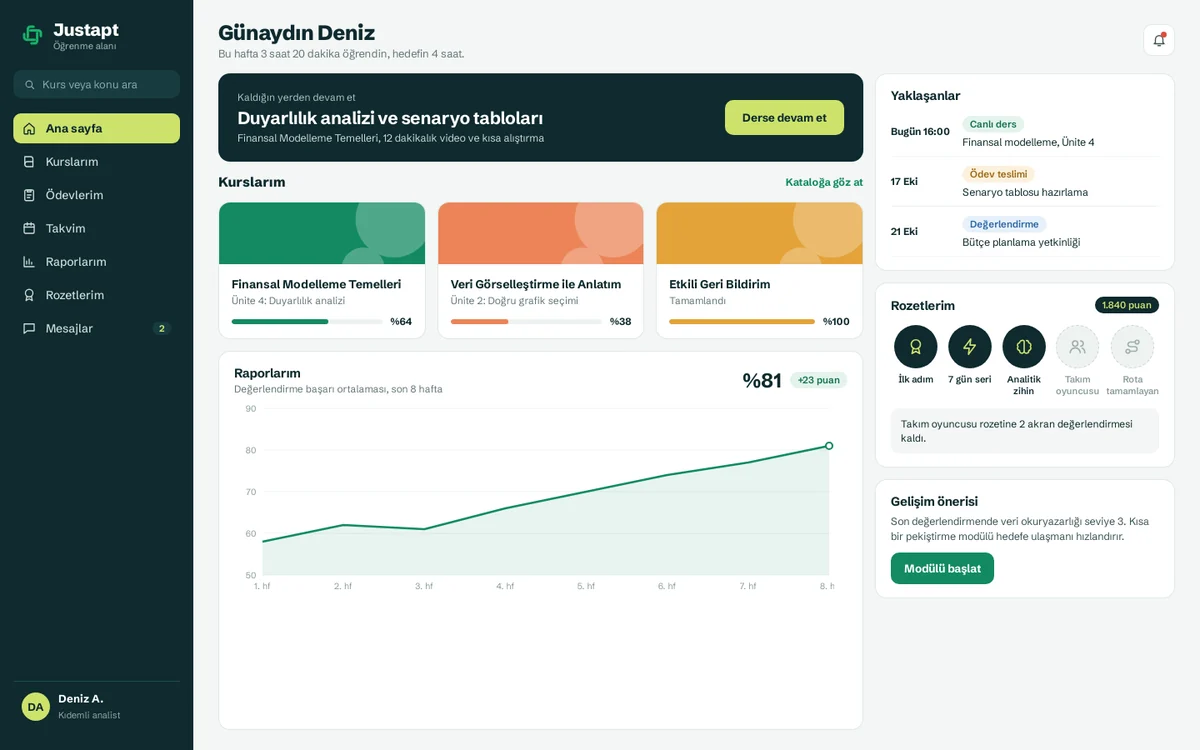
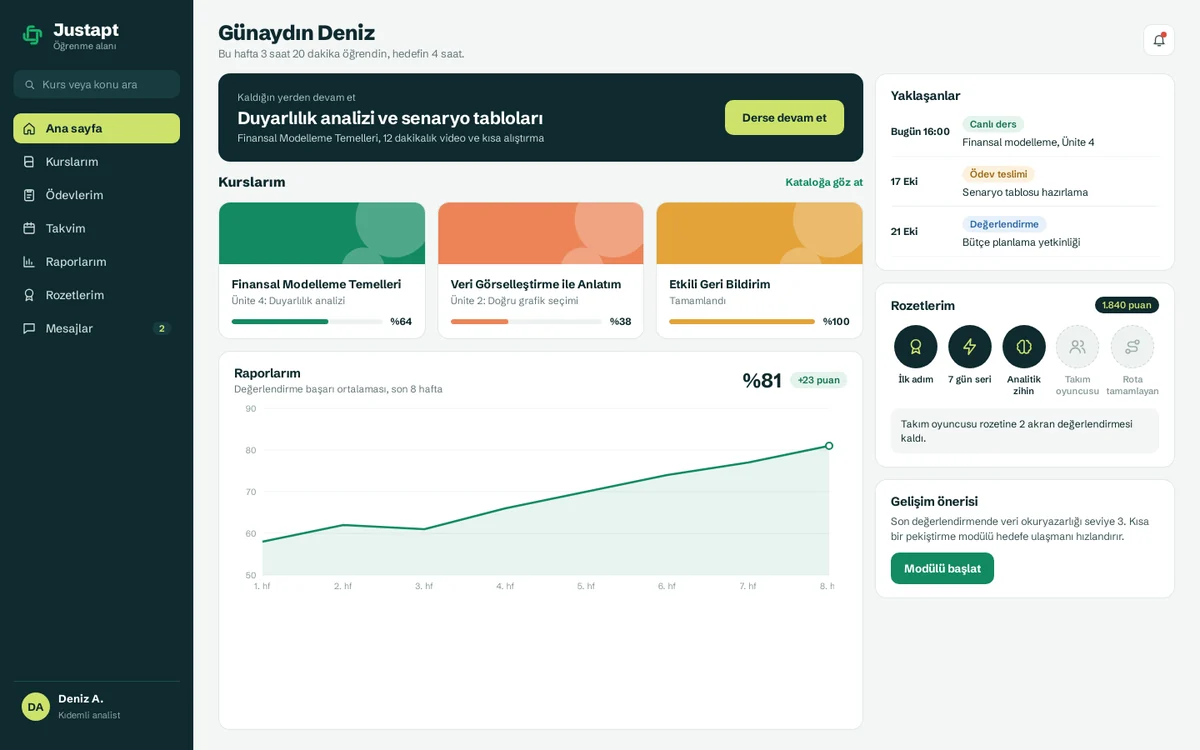
The learner area is where employees take ownership of their own development: on opening, the lesson they left off at appears, and a single button takes them back to it. Course cards show the completion percentage and the next unit; upcoming live lessons, assignment submissions, and assessments are listed in the side column. Badges, points, and streaks support learning continuity, and reports show the weekly performance trend.

Learner area

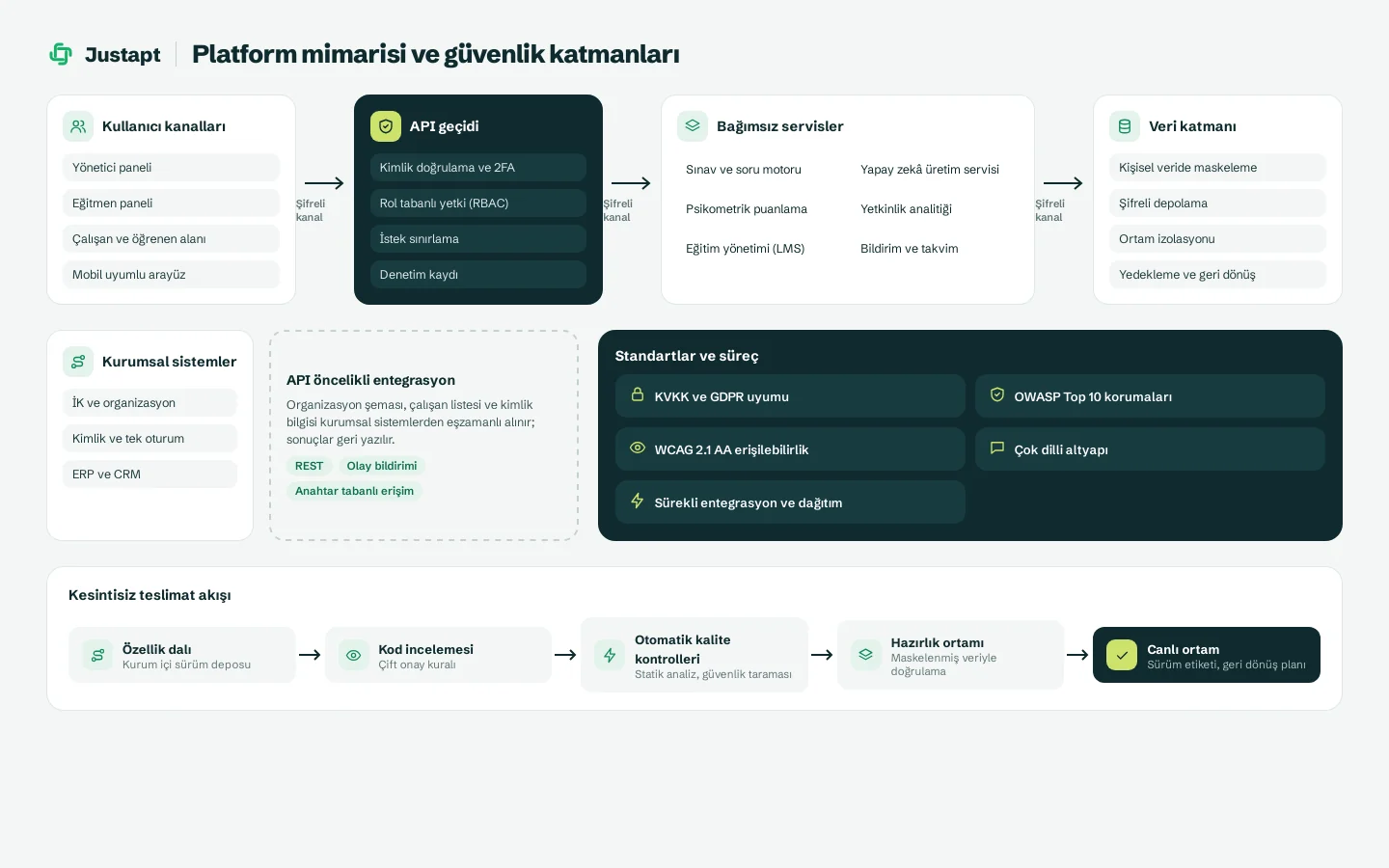
Architecture and security

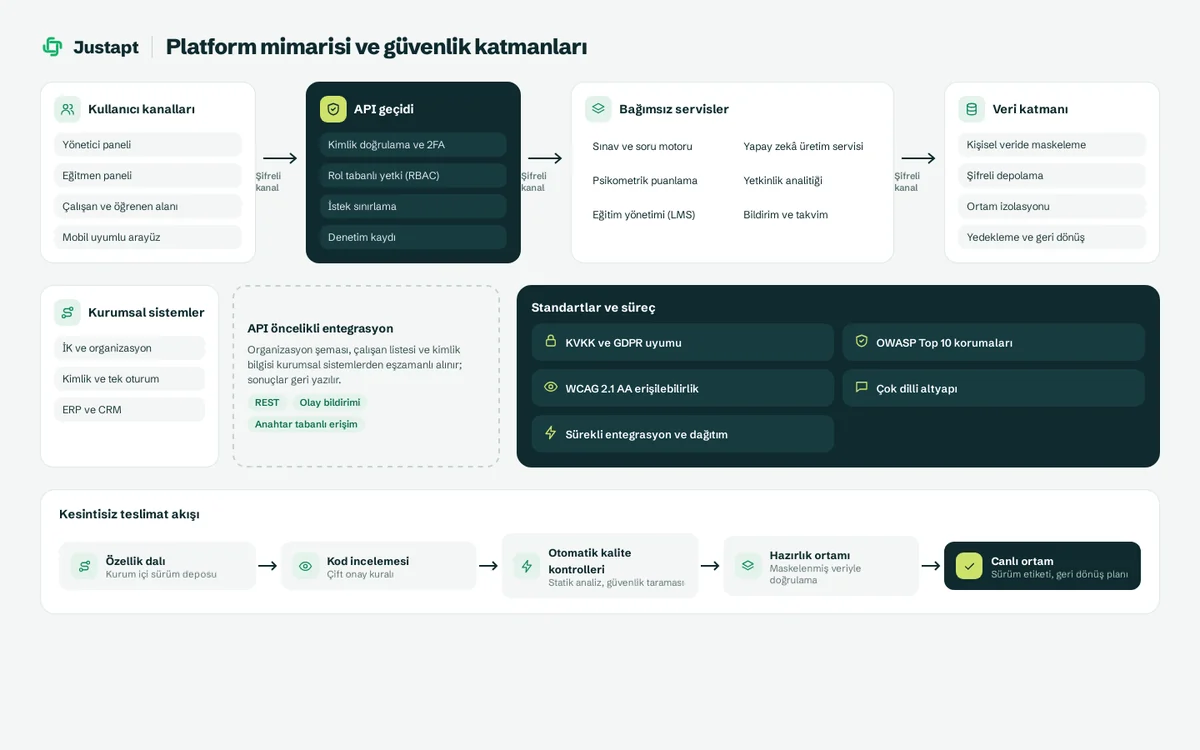
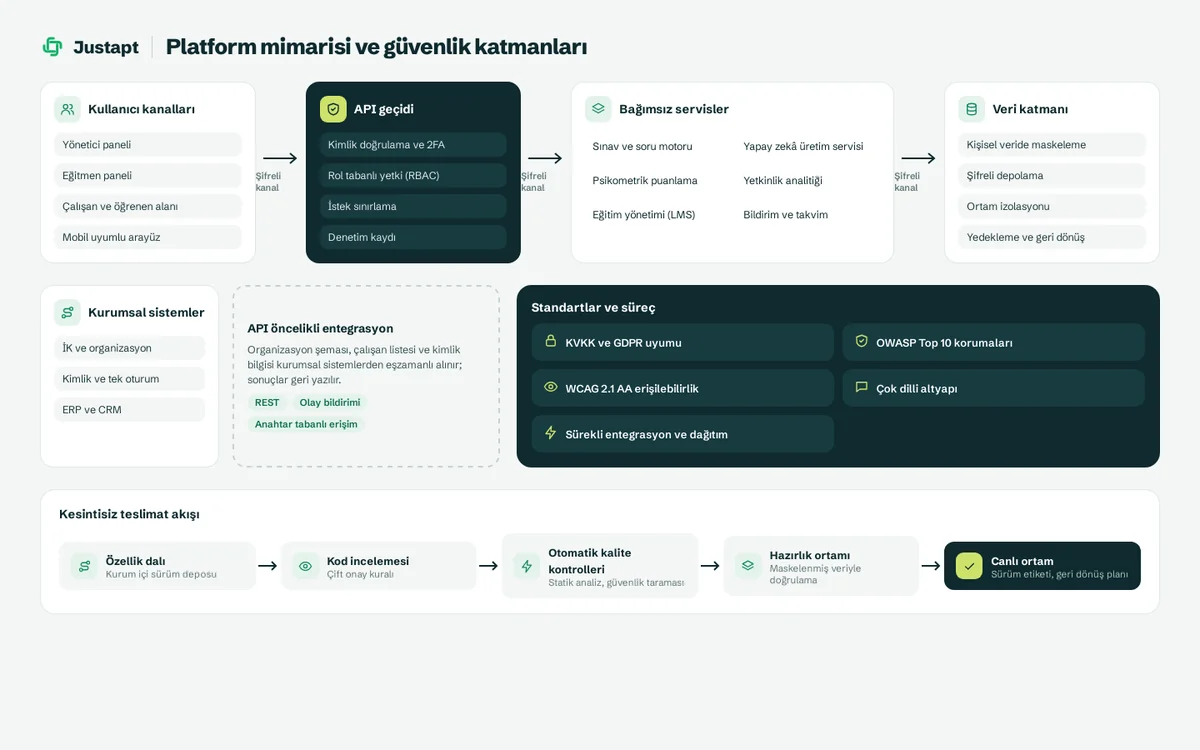
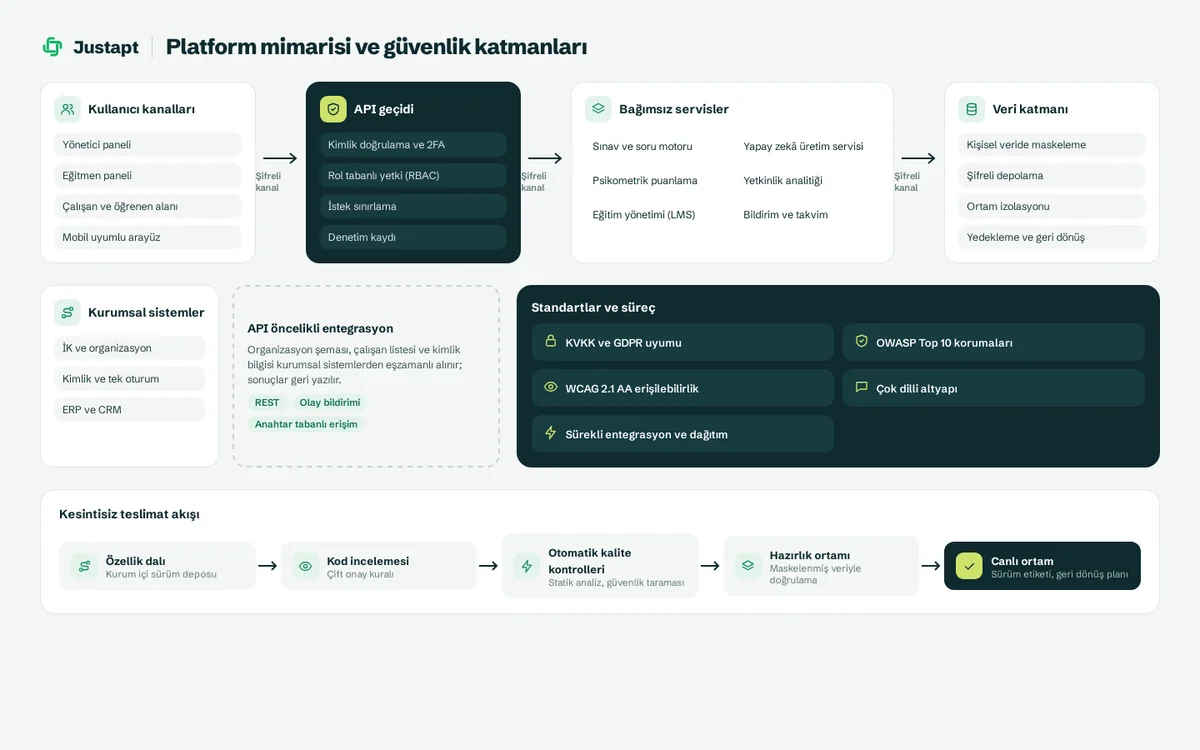
Requests from the manager, instructor, and employee interfaces reach the API gateway over an encrypted channel; the gateway handles authentication, role-based authorization, rate limiting, and audit logging. The exam, psychometrics, analytics, and training capabilities run as independent services and scale piece by piece. Data is stored encrypted; non-production environments work only with masked data.

Architecture and security
Features

Key features of the project

Prompt-based exam generation

Prompt-based exam generation

The manager writes what they want to measure in their own words; questions matched to a competency and level are ready in seconds.

Expert-approved publishing

Expert-approved publishing

Every question is reviewed, edited with a prompt, or regenerated; no question goes live without approval.

Automatic quality control

Automatic quality control

Checks for competency distribution, difficulty balance, a single correct answer, and duplicates are reported for every set.

Five-level competency model

Five-level competency model

One shared scale is used across the entire organization, from the “Needs development” level to the “Can coach” level.

Role-based skills matrix

Role-based skills matrix

When a department and role are selected, target levels are loaded and gaps appear as level differences.

AI insights

AI insights

Critical gaps, high-potential employees, and signs of decline are flagged automatically.

Flexible or proctored exam

Flexible or proctored exam

Flexible mode is used for development-oriented measurements; proctoring with camera, microphone, and tab tracking is used for critical decisions.

Interruption-proof saving

Interruption-proof saving

Every answer is written to the server instantly; no data is lost even if the connection drops.

Four psychometric scales

Four psychometric scales

A personality inventory, psychological resilience, abstract reasoning, and a general ability battery run on the same platform.

Culture fit score

Culture fit score

Behavioral tendencies are numerically compared with the profile the organization expects.

Career progression matrix

Career progression matrix

Competency expectations are defined for each career step and compared with the person’s current level.
Promotion readiness indicator

Promotion readiness indicator

An estimated readiness time is calculated based on the number of gaps and the recommended path.

Automatic development path

Automatic development path

Training, practice, and mentoring steps are selected from the organization’s training catalog and assigned to the employee.

Integrated learning management

Integrated learning management

Courses, classes, assignments, calendar, announcements, messaging, and newsletters are managed from a single center.

Gamification

Gamification

Badges, points, and streaks support learning continuity.

Role-based access

Role-based access

Managers, instructors, and employees see only the data they are authorized to see; the principle of least privilege is applied.

Data masking and environment isolation

Data masking and environment isolation

Only masked data is used in all non-production environments.

API-first integration

API-first integration

A two-way, synchronous data flow is provided with HR, identity, and ERP/CRM systems.

Accessible and multilingual

Accessible and multilingual

Offers an infrastructure that is WCAG 2.1 AA compliant, screen-reader friendly, and ready for multiple languages.

Keep scrolling

Project presentation

Presentation

Move between slides with the arrow keys or by swiping.

Full screen (opens in a new tab)

How we work

Your project could be next

This project was run on the same four principles; yours will be too.

  1. We start with analysis

    Scope, integrations and roadmap are written down and agreed in the first weeks; no surprises along the way.

  2. We don't touch your existing systems

    ERP, accounting, banking, e-invoicing: whatever you run, we integrate on top of it and your data stays where it is.

  3. Security is designed in from day one

    Role-based access, two-factor authentication, data-protection compliance and a log of every action are built into the foundation, not bolted on later.

  4. We're still here after go-live

    Maintenance, monitoring and new releases come from the team that built the project; someone who knows your system is always a call away.