


 RAMS PDKS
The first week at a new construction site. The container office is in place; full-height turnstiles have been installed at the main entrance, a tripod turnstile at the service gate, and card reader panels at the office and door access points. Internet comes from an LTE modem in the corner of the container. The devices are ready, and staff have received their cards. Only one question remains: how will the head office see these turnstiles?
In a conventional time and attendance (PDKS) setup, the answer to this question runs through network settings: port forwarding on the modem, a NAT rule, an opening in the firewall, and a static IP address that all of them rely on. On a construction site, none of these is permanent. The part of RAMS PDKS we put the most effort into took shape around exactly this question.
The project in brief
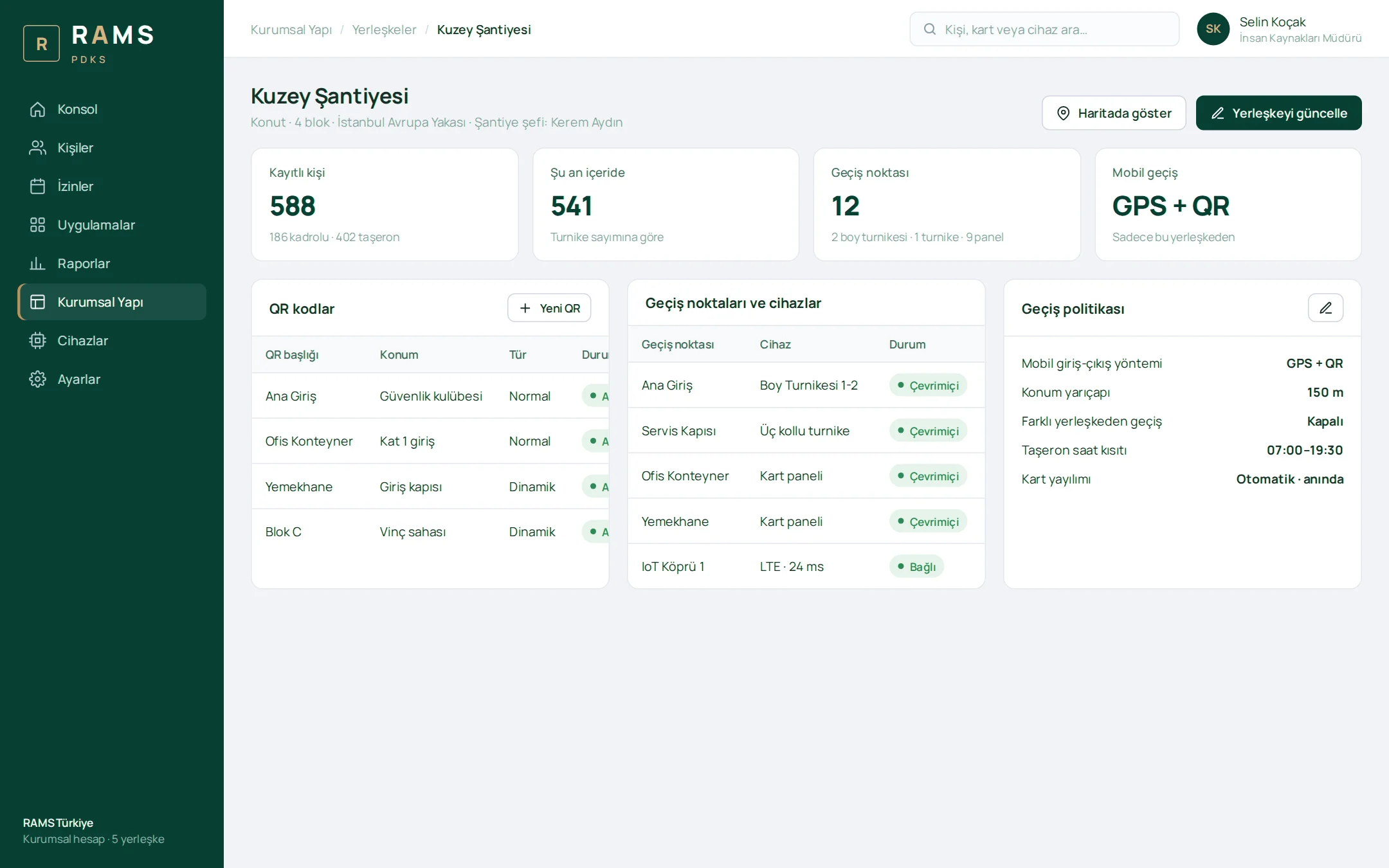
RAMS PDKS is a fully cloud-based time and attendance and human resources platform that centrally manages the entries and exits of permanent and subcontractor staff working at RAMS Türkiye's head office, sales offices and construction sites. On site, staff pass through a full-height or tripod turnstile with their card; card reader panels are used in the offices, and field and office staff use a mobile app with QR and location verification. The web management panel, the iOS and Android app, the IoT connectivity layer and the integration API that works in both directions with enterprise HR and ERP systems are all parts of the same platform. This article covers one of those layers: the IoT gateway that connects on-site devices to the cloud.
On a construction site, the network is temporary
RAMS Türkiye runs several large-scale construction sites at the same time. Entrances were controlled with turnstiles before the project too, but the devices at each site worked in isolation, cards were defined locally and data was collected at the end of each period. The head office could not see the real-time status of the sites.
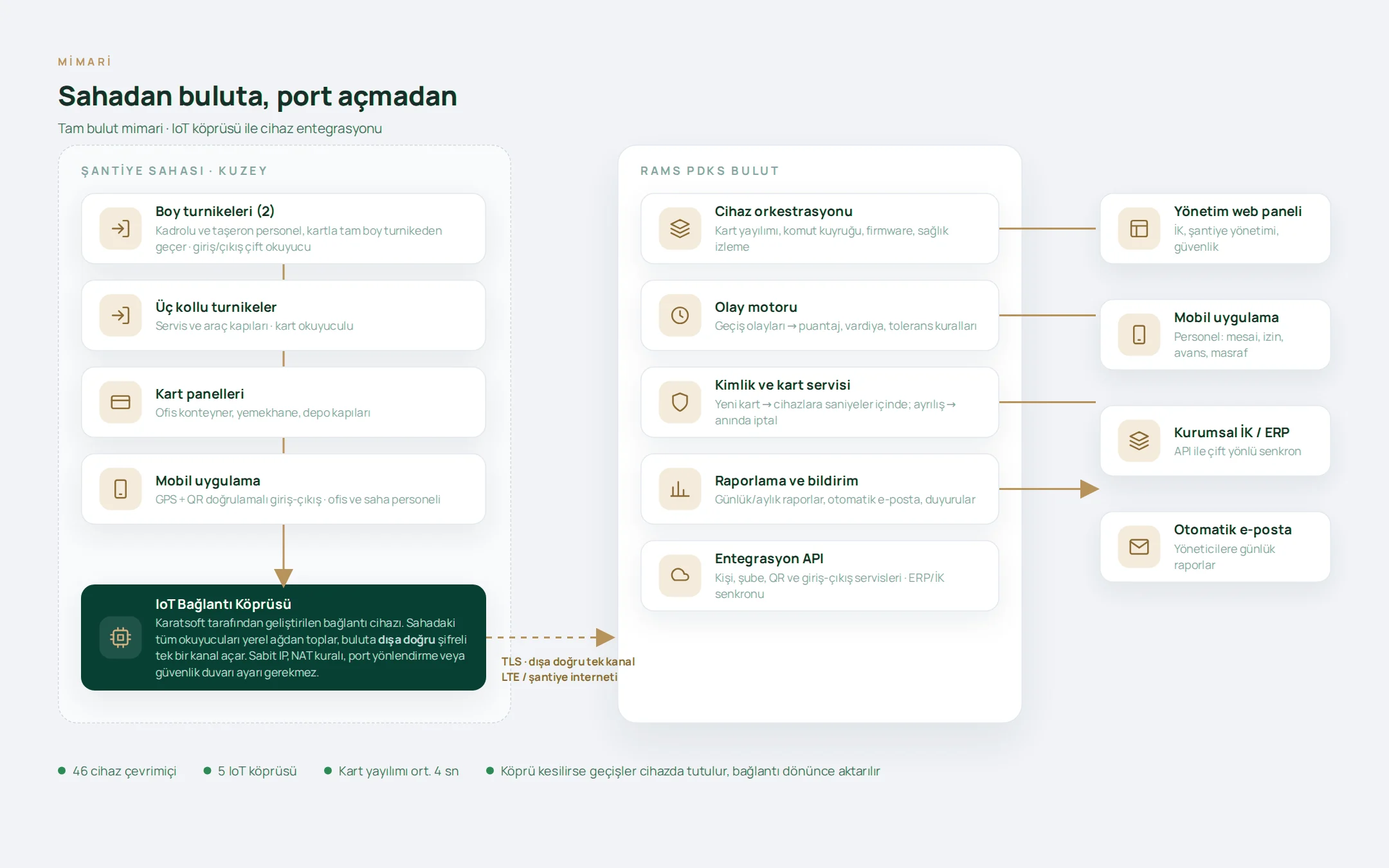
The obstacle to connecting the devices to the center was the construction site itself. Internet on site usually comes through an LTE modem; there is no static IP, and modems and carriers change frequently. Because conventional time and attendance devices expect the central system to reach them from outside, every site needs port forwarding, NAT rules and firewall settings. These settings had to be redone at every site, and often could not be done at all.
Setting up the same network configuration from scratch at every new site meant making the system dependent on a temporary modem rather than on permanent infrastructure. So we changed the question: instead of asking how the center reaches the device, we asked how the device reaches the center.
We reversed the direction of the connection
The answer was the IoT gateway that Karatsoft developed for this purpose. One is installed at each construction site. The gateway collects the full-height turnstiles, tripod turnstiles and card reader panels on site over the local network and opens a single encrypted outbound channel to the cloud. Because the connection is established from the inside out, there is no need for a static IP, NAT rules, port forwarding or firewall settings. And when the modem or carrier changes, there is no network configuration to redo.
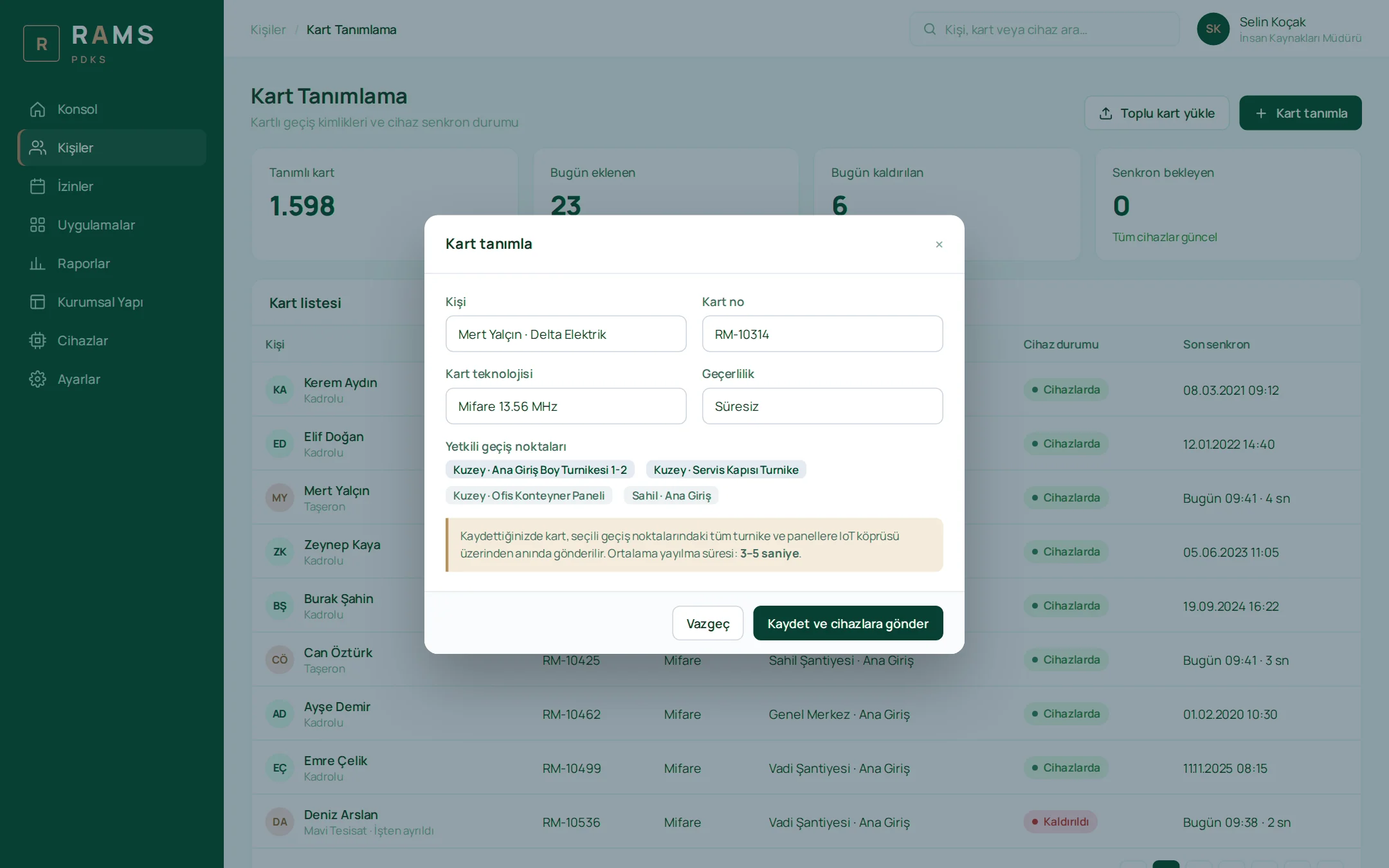
Once the channel is open, all devices on site are managed centrally in real time. When a new card is enrolled, it travels this way to the relevant turnstiles; when someone leaves, their card is removed the same way. As a result, every new construction site can be managed centrally as soon as the devices are installed and the gateway is plugged in. There are no servers, licenses or local installations; adding a new site, device or user requires no infrastructure changes.
When the connection drops, passes are not lost
On a site that runs on LTE, you have to assume from the start that the connection will drop one day. That is why, when the connection is lost, passes are kept on the device and transferred in full once it returns. The record of a worker who passed through the turnstile in the morning finds its place in the timesheet even if the line is down for a while.
Every pass from the site merges into a single event stream, regardless of device type. Passes from full-height turnstiles, tripod turnstiles, card reader panels and QR and GPS check-ins in the mobile app all feed the same timesheet; shift, tolerance and break rules run on top of this stream. Even if the device brand or type changes, the logic of the report does not.
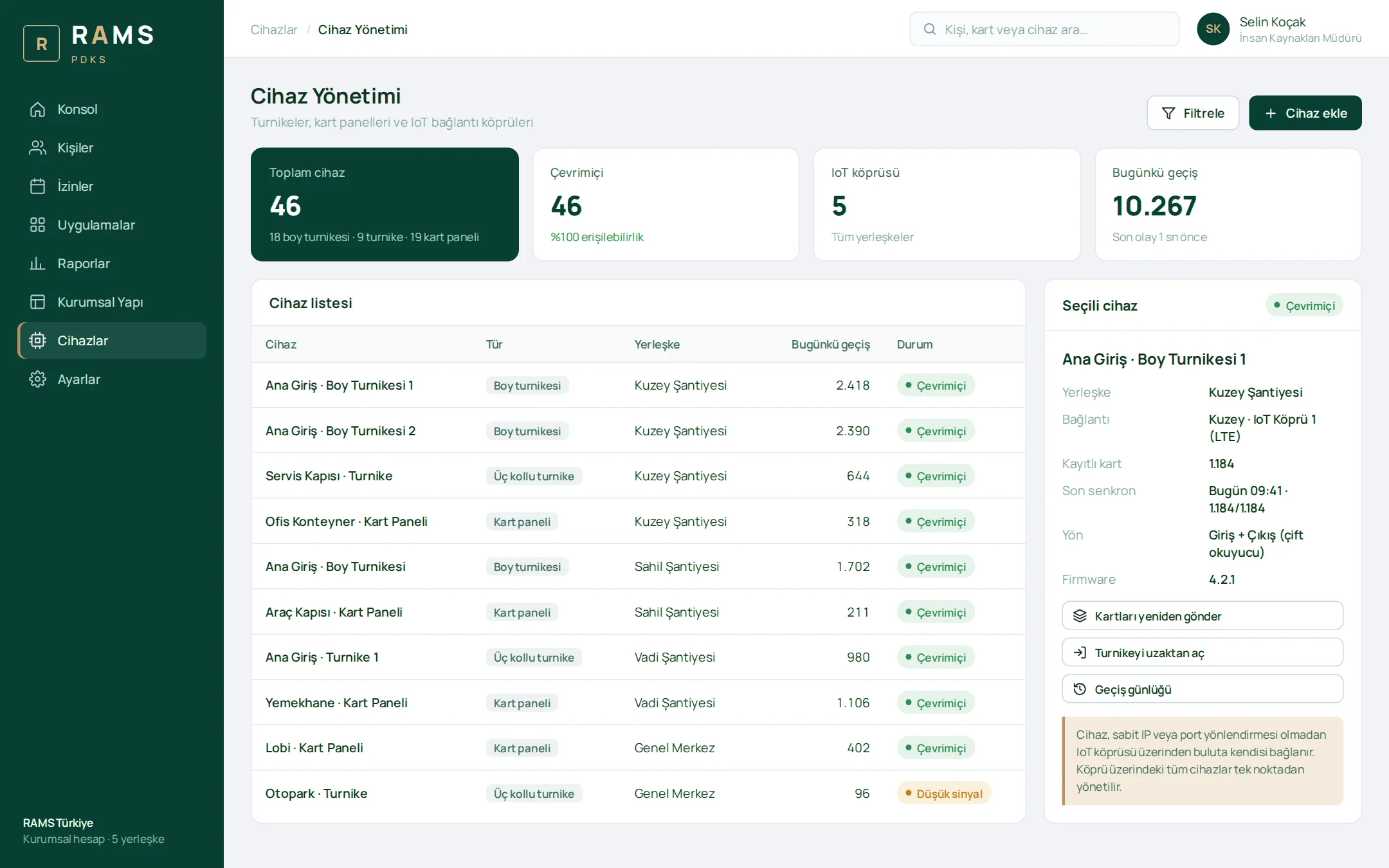
For the team watching from the center, the health of the site is visible too. On the device management screen, full-height turnstiles, tripod turnstiles, card reader panels and IoT gateways are listed by site, and each device's online status, today's pass count, number of registered cards and last sync time are monitored. When needed, cards are resent to the device and the turnstile is opened remotely.
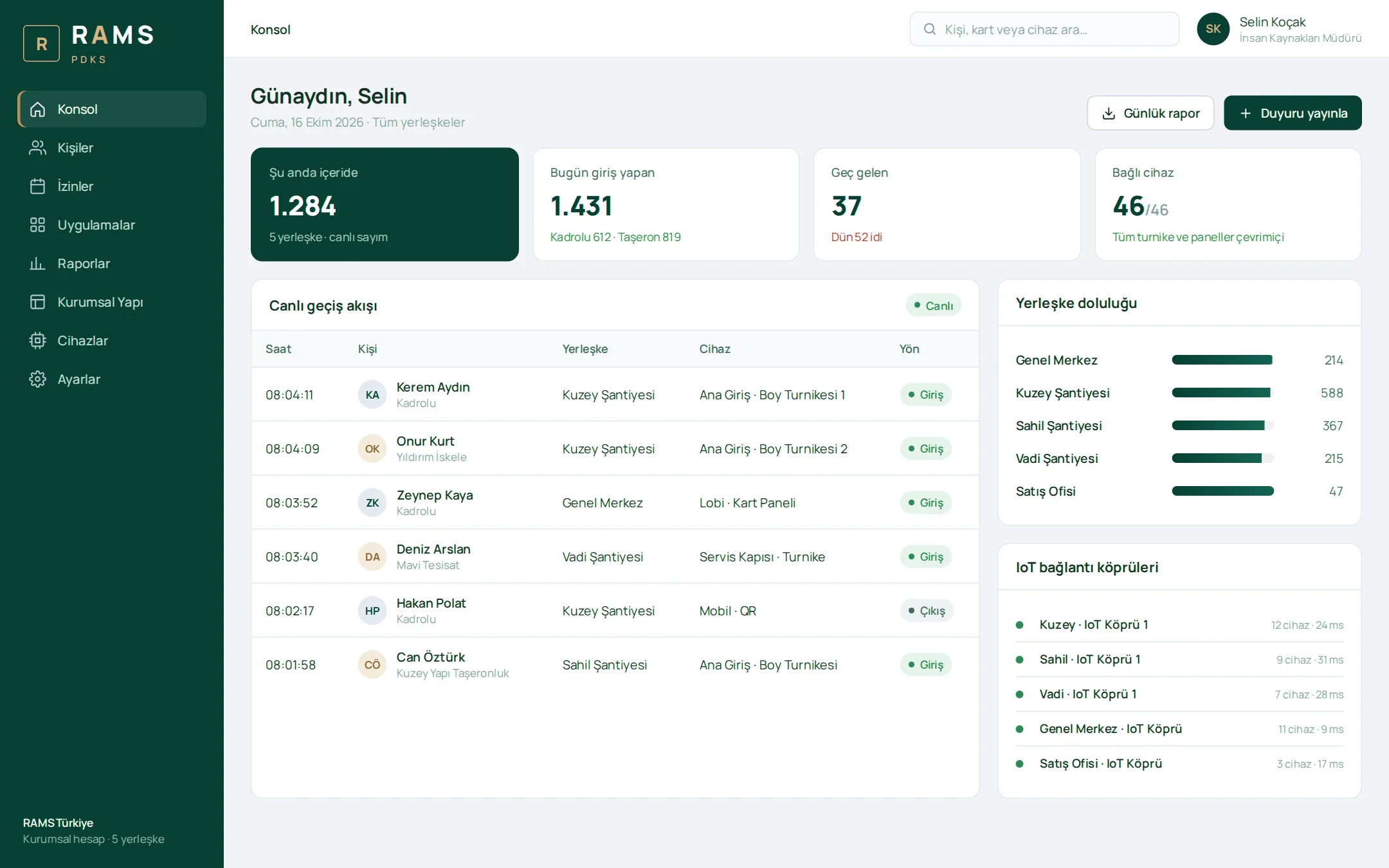
The management console brings all sites together: the number of people currently inside, daily entries, late arrivals and connected device status on a single screen. Passes from turnstiles and panels flow in live, with site occupancy and the health of the IoT gateways monitored alongside. Data that used to be collected at the end of each period now reaches the head office the moment a pass is made.
What we learned on site
- Don't expect the network to adapt to you. On a construction site, modems, carriers and lines change; if you build the system to depend on network settings, every change creates a new installation job on site.
- Establish the connection from the inside out. A single encrypted outbound channel connects the device to the center without opening any door on site.
- Treat disconnection as normal. When the connection drops, the pass waits on the device; an outage does not mean data loss.
- Dissolve device types into the event stream. When turnstiles, panels and phones write to the same timesheet, the report does not have to deal with device brands.
- Monitor the health of the site like data. A fault in a device whose online status and last sync time are visible is noticed without waiting for word from the site.
On a construction site, the value of a time and attendance system comes less from how advanced the device is than from its ability to work without anyone having to go to the site to configure the network.
What are your site's turnstiles connected to?
If you have several construction sites, or warehouses or production areas without a static IP, and your turnstiles still work in isolation, we can adapt the same approach to your site. You can explore the full platform on the RAMS PDKS project page or get in touch with us.
About the author
Selin Kaya
Digital Content Specialist
As a digital content specialist at Karatsoft, she prepares the blog articles. She explains in plain language what the products and projects are for and how they are used.



Comments
0No comments yet. Be the first to comment!
Leave a Comment
Feel free to share your thoughts and feedback with us.