


 Evion EV Charge
A driver plugs the car in to charge and goes off to get a coffee. Just then the charger's connection drops. The tariff is about to change at midnight, and there is hardly any limit left on the driver's card. These three small possibilities mean three separate questions for a charging network: When the energy supply is cut, how will the amount be calculated? Which price will apply? Where will the payment be collected from?
The answers to these questions sit at the core of Evion EV Charge. We started the project from the realities of the field: a charger's connection drops, a driver's phone shuts off, a QR code won't scan, a bank verification is left half-finished. We designed the platform around these exceptions.
The project in brief
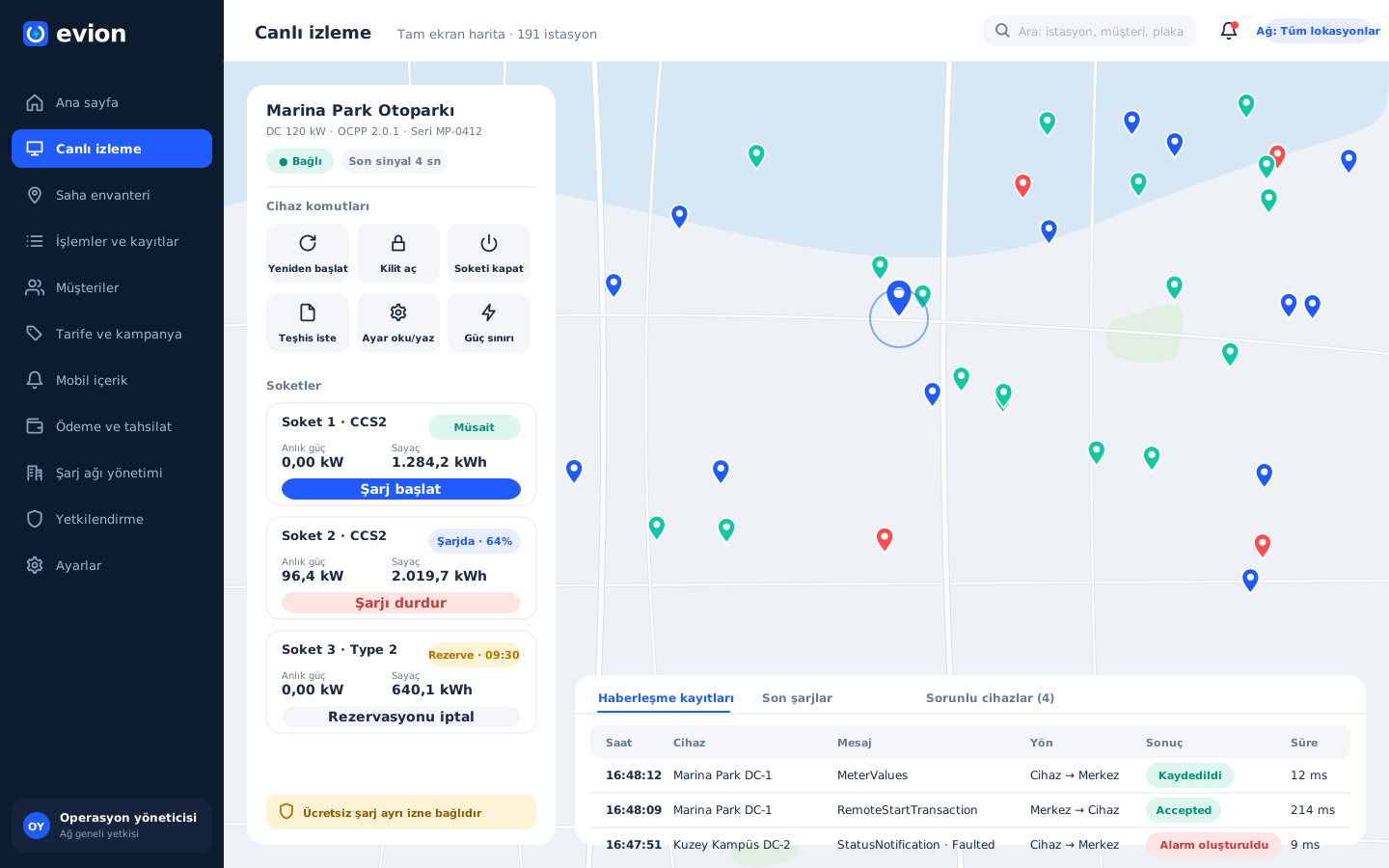
Evion EV Charge is a platform that runs an electric vehicle charging network from a single hub: OCPP-compliant charger management, a browser-based admin panel, an Android and iOS driver app, a wallet and automated EPDK (Energy Market Regulatory Authority) and GİB (Turkish Revenue Administration) processes, all in the same place. The request we received was to manage a charger fleet made up of different brands from a single screen, to offer drivers an app under the operator's own brand, and to carry out legal obligations without manual intervention.
If the amount is uncertain, so is the collection
At the start of a charge, it is not known how much energy will be taken. That is why the model of debiting the card at the end of the charge depended on three things: the card limit, the bank verification and the connection. When one of them faltered, the result was a transaction whose charge had finished but whose payment had not been collected.
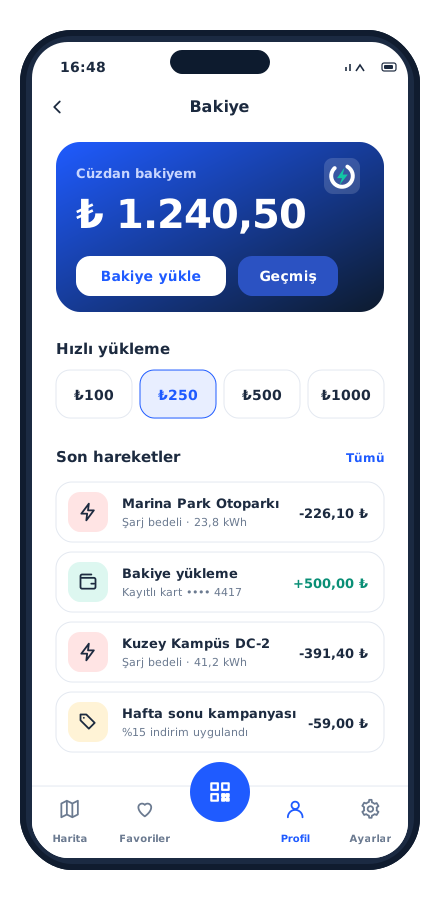
We reversed the model: wallet first, then charge. Drivers top up their balance in advance with their card, and every top-up goes through the bank's 3D Secure verification. The charging fee is deducted from the balance at the end; because this deduction does not depend on any external system, it completes under all conditions. The card number is not stored on the platform but with the payment provider; the panel shows only the last four digits, the card brand and the cardholder.
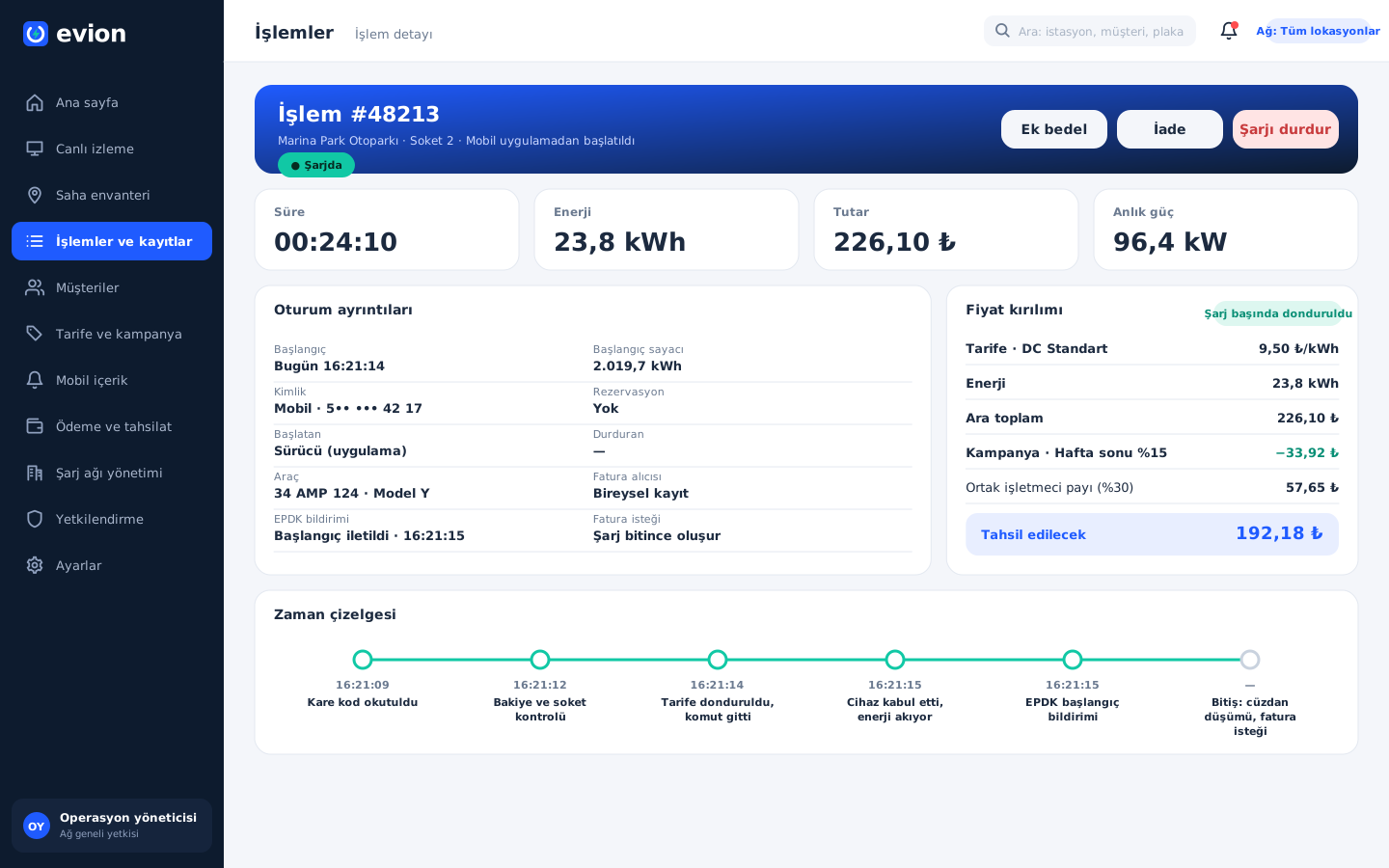
Because the energy to be taken cannot be known in advance, the balance can go negative. Two rules work together for this: until the negative balance is cleared, no new charge can be opened for the same driver from any of the phone, card or panel channels, and no other top-up is posted to the wallet. This keeps the operator's shortfall limited to at most one charge's fee. If the card step is left unfinished, only the top-up fails to take place; no ongoing charge is affected.
The checks also run before a charge starts. When the driver scans the QR code, the central system checks whether the balance is negative, whether a charge is already in progress and whether the connector is free; if a check fails, the charge is not started. A driver with a negative balance is asked to top up their balance; the outstanding amount can be paid with a single tap from the transaction details or the balance screen.
The price freezes the moment the charge starts
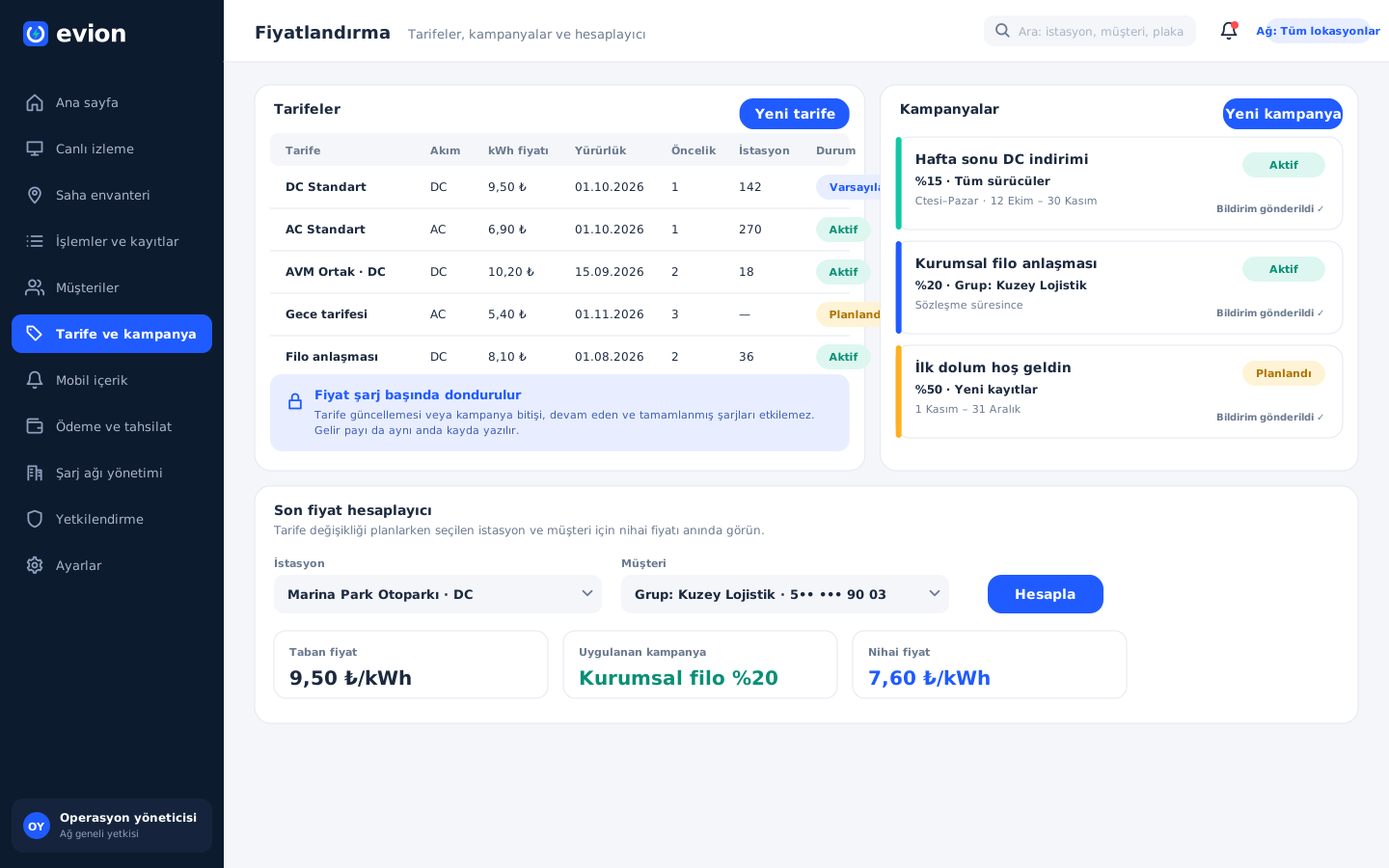
A tariff update or the end of a promotion made the amount of ongoing charges and the revenue share of the partner operator uncertain. The solution is simple but exact: the tariff, the discount and the revenue share are written to that charge's record at the moment the charge starts. Even if the tariff changes later, ongoing and completed charges are not affected. The amount is found by multiplying the difference between the end and start meter readings by the tariff written to the record at the start of the charge and then deducting the discount; the driver sees this breakdown in the transaction history.
There is also a safeguard for the operations team preparing to change a tariff: the final price calculator shows the base price, the applied discount and the final price for the selected station and customer before the change is made. Corporate discounts, in turn, are given through promotions attached to a customer group, without touching the tariff. Because tariffs are defined by current type, effective date and priority, different prices can be applied to different locations in the same network.
When the connection drops, no energy is left unaccounted for
In the old setup, when a charger's connection dropped during a charge, the session stayed open, no meter value arrived and the energy could not be collected. In Evion EV Charge, an open charge does not stay open indefinitely; the system closes it at the last meter value read and bills it. If the meter value is inconsistent, the amount is not calculated at all, and the charge waits in the records to be reviewed. A faulty reading is not passed on to the customer as a wrong amount.
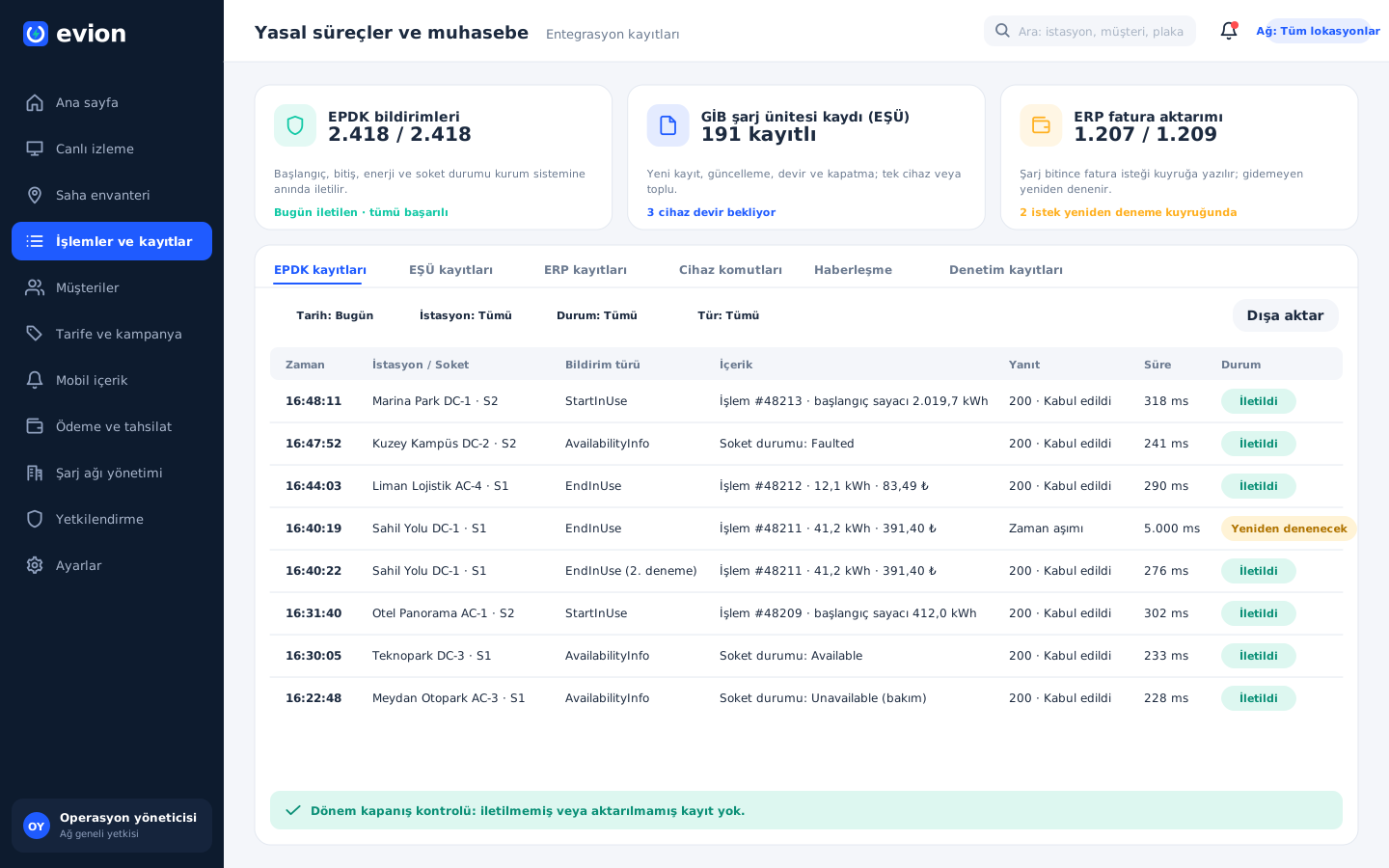
When a charge closes, a chain runs on its own in the background: the amount is deducted from the wallet, a completion notification goes to the EPDK, an invoice request is created for accounting and a notification is sent to the driver. Official notifications and invoice requests run through a queue; a request that fails to go out is retried, and a second request for the same charge is blocked. Whether any record is left untransferred at period close can be seen at a glance on the log screens.
Faulty or incomplete collections also have a defined way of being corrected. A full or partial refund can be made; a full refund made on the same day is processed as a payment cancellation, and one made after that as a repayment. An amount that was collected short is added to the relevant charge afterwards and deducted from the balance, and a notification goes to the driver. Both operations require separate permissions and are recorded with their reason and the user who performed them. Top-ups, charging fees, refunds, additional charges and manual corrections all appear in the same transaction list, both in the app and in the panel.
What we learned in the field
- Decouple collection from external systems. Because deducting from the balance is independent of the bank's status at that moment, every charge closes with an amount.
- Cap the shortfall with a rule. A negative balance is not banned outright, but it cannot exceed the fee of a single charge.
- Lock the price at the start of the event. A tariff change stops being a risk that affects ongoing transactions and becomes a setting that can be made safely.
- Do not invoice suspicious data. An inconsistent meter value goes to review instead of being calculated.
In a charging network, trust is not earned in the most ordinary charge but in the exceptions: when the connection drops, when the card falls short and when the tariff changes.
Which exception breaks your transaction?
If you run an operation whose collection depends on an external system, whose price can change in the middle of a transaction, or whose record is left half-finished by an outage, we can adapt similar rules to your own business model. You can browse the whole platform on the Evion EV Charge project page and get in touch with us.
About the author
Selin Kaya
Digital Content Specialist
As a digital content specialist at Karatsoft, she prepares the blog articles. She explains in plain language what the products and projects are for and how they are used.



Comments
0No comments yet. Be the first to comment!
Leave a Comment
Feel free to share your thoughts and feedback with us.